Spongia Tosta
Overview:
Spongia Tosta emerges from the ocean’s depths. This remedy answers the desperate, brassy call of a larynx as dry as the desert wind, where each breath is a labour and every cough sounds like timber rending. It is a balm for the soul awakened in terror, casting out the spectral dread that whispers of suffocation in the quiet dark before midnight, bringing stillness to the panicked heart and calm to the constricted throat.
Memory Tips for Guiding Symptoms
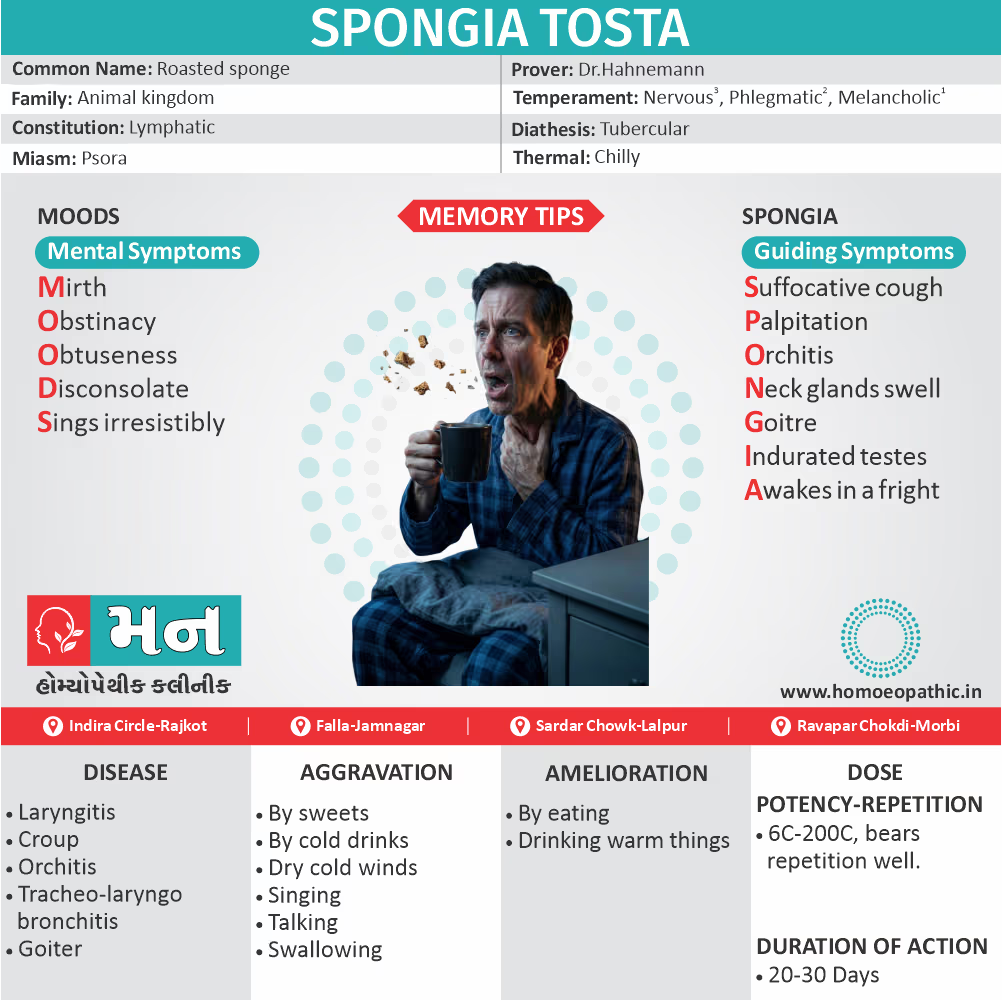
Hi Friends Let’s memorize guiding symptoms of Spongia Tosta through name of Medicine ‘SPONGIA’.
S
P
O
N
G
I
A
S
S – Suffocative Cough
Description: The cough associated with Spongia Tosta is a hallmark symptom. It is characteristically dry, harsh, and barking, often compared to the sound of a saw being driven through a pine board. This croupy cough typically worsens before midnight and is accompanied by an intense feeling of suffocation, causing the patient to wake up in a state of fright. The larynx is extremely sensitive to touch, and there is great dryness in all air passages.
Reference: [Boericke’s Pocket Manual of Homoeopathic Materia Medica by William Boericke]
P
P – Palpitation
Description: Spongia is indicated for severe cardiac symptoms. Patients experience violent, rapid palpitations with a loud cough. They are often roused from sleep suddenly with a feeling of suffocation, intense anxiety, and pain in the chest. This state can be mistaken for a severe heart attack, accompanied by a flushed face and gasping for breath.
Reference: [Lectures on Homoeopathic Materia Medica by James Tyler Kent]
O
O – Orchitis
Description: This remedy is a primary choice for inflammation and swelling of the testicles, known as orchitis. The condition often arises after an injury, a suppressed infection like gonorrhoea, or from getting chilled. The testes become swollen, hard, and are painfully sensitive, with a stitching or bruised pain that can extend up into the spermatic cord.
Reference: [Leaders in Homoeopathic Therapeutics by E. B. Nash]
N
N – Neck glands swell
Description: Spongia Tosta has a profound effect on the glandular system, particularly the lymphatic glands of the neck. It is indicated for the swelling and hardening of cervical glands. These glands can become significantly enlarged and feel dense or indurated upon palpation, often associated with throat and respiratory complaints.
Reference: [A Synoptic Key of the Materia Medica by Cyrus Maxwell Boger]
G
G – Goitre
Description: This is one of the most well-known indications for Spongia. It is used for the enlargement of the thyroid gland, or goitre, where the gland feels hard and swollen. A key feature is the accompanying suffocative spells, especially at night. The patient often feels a constricting sensation in the throat, as if they are breathing through a sponge.
Reference: [Allen’s Keynotes of Leading Remedies of the Materia Medica by H. C. Allen]
I
I – Indurated testes
Description: Beyond simple inflammation, Spongia addresses the hardening, or induration, of the testes. Following an episode of orchitis, the testicles may remain enlarged and become stone-hard. This chronic induration is a significant keynote for the remedy, often accompanied by a persistent dull ache or drawing pain.
Reference: [A Dictionary of Practical Materia Medica by John Henry Clarke]
A
A – Awakes in a fright
Description: A classic Spongia symptom is the patient starting from sleep in a state of terror. They wake up suddenly, just after falling asleep, with an extreme fear of death and a feeling of impending suffocation. This is often linked to the dry, constrictive state of the larynx or cardiac issues, making them feel as if they cannot breathe.
Reference: [Concise Materia Medica of Homoeopathic Remedies by S. R. Phatak]
Memory Tips for Mental Symptoms
Hi Friends Let’s memorize mental symptoms of Spongia Tosta through name of Medicine ‘PANIC’.
M
O
O
D
S
M
M – Mirth
Description: “Immoderate and mischievous gaiety.”
Reference: [Dictionary Of Practical Materia Medica (All 3 Vol.) By Clarke J. H.]
O
O – Obstinacy
Description: “Obstinate and improper behavior.”
Reference: [Nature’s Materia Medica By Robin Murphy, Md]
O
O – Obtuseness
Description: “Mental obtuseness, with complete disinclination and incapacity for attending to intellectual labour.”
Reference: [Dictionary Of Practical Materia Medica (All 3 Vol.) By Clarke J. H.]
D
D – Disconsolate
Description: “Disconsolate and lachrymose humor.”
Reference: [Dictionary Of Practical Materia Medica (All 3 Vol.) By Clarke J. H.]
S
S – Sings irresistibly
Description: “Irresistible desire to sing, with excessive mirth.”
Reference: [Condensed Materia Medica By Hering C.]
Introduction
Constitution
Clinical
Mental Symptoms
Guiding Symptoms
Characteristic
Therapeutic Value
Modality
Remedy Relationship
Dose
Terminologies
Reference
Also Search As
Introduction
Introduction of Spongia Tosta
Common name:
Roasted sponge[1]
Synonyms
–
Family / Group / Class / Order
Animal kingdom
Habit and habitat / Description
Derived from the roasted sea sponge, the homeopathic remedy Spongia tosta is primarily indicated for intense respiratory and laryngeal complaints. Its most prominent feature is a dry, harsh, barking cough, often compared to a saw cutting through wood, which is accompanied by extreme dryness of all air passages. Clinically, it is used for conditions like croup, goitre, and orchitis, with symptoms characteristically worsening before midnight and causing the patient to awaken suddenly with an overwhelming fear of suffocation.[2]
Formula / Symbols
–
Name of prover
Dr Hahnemann
Introduction and history
It is a deep and slow acting remedy. According to Hahnemann, toasted sponge was first mentioned as a specific for goitre by the chemist, Arnol von ilanold in the thirteenth century but it was generally mixed with other substances where it failed in curing the disease till Hahnemann proved it.
Doctrine of signature
–
Parts used
Whole sponge
Active principles
Spongia contains iodine which is responsible for many of the symptoms produced by it. However, it contains other elements besides iodine also.
Preparation
It is prepared from the tincture by taking 20 grains of the tincture in 400 drops of alcohol.
Constitution
Constitution of Spongia Tosta
Physical make up
It is especially adapted to diseases of children and women who are of light hair, lax fibre and fair complexion.
Temperament
Nervous 3 , Phlegmatic 2 , Melancholic 1
Diathesis
Tubercular
Relation with heat & cold
Chilly
Miasm
Psora
Clinical
Clinical conditions of Spongia Tosta
Aneurism. Angina pectoris. Asthma. Catalepsy. Chin, affections of. Clumsiness. Constipation. Cough. Croup. Diplopia. Exophthalmos. Fainting. Goître; exophthalmic. Heart, hypertrophy of. Hernia. Jaw-joint, pain in. Laryngismus. Laryngitis. Myopia. Rheumatic fever. Rheumatism. Testicles, inflammation of. Tuberculosis. Varicosis. Whooping-cough. Worms.
Sites of action / Pharmacodynamics
It acts on the mucous membrane of air passages, respiratory organs, glands, male genital organs, etc.[3]
Causation (Causes / Ailments from)
Every mental excitement, suppressed gonorrhoea, maltreated
orchitis.
Physiological action
This agent produces enlargement and induration of the glands; inflammation of the mucous membranes of the larynx and trachea. It also exerts an influence on the nutrition of the heart.[4]
Patho-physiological changes / Pathogenesis
1. Affects the heart valves, larynx, trachea and glands, especially ductless
glands. A remedy especially marked in the symptoms of respiratory organs,
cough, croup, etc.
2. Acts on the glandular system producing enlargement and induration of
glands; especially affects the thyroid and testicles.
3. Acts on mucous membranes producing inflammation; especially that of the
larynx and trachea; with great hoarseness, aphonia and a dry, barking cough
along with obstruction of respiration as if a plug were there.
4. It acts on the heart and affects the nutrition of heart producing lack of
nutrition; fibrinous deposits upon the valves.
5. Acts on blood producing increased fibrin and anaemia.
Mental Symptoms
Characteristic Mental Symptoms (psychology) of Spongia Tosta
1. Patient awakens in a fright and feels suffocated, as if he had to breathe
through a sponge.
2. Every mental excitement increases the cough.
3. Patient weeps with dreams, whooping cough, fever, sweat.
4. Patient is despondent about loss of sexual power.
5. Patient has an irresistible desire to sing with excessive mirth
Guiding Symptoms
Guiding Symptoms of Spongia Tosta
Generalities
Toasted sponge contains small percentage of iodine. It affects the HEART esp. valves; larynx; trachea and glands esp. ductless. It is suited to fair haired women and children, of LAX FIBRE, flabby and scrofulous constitutions. Exhaustion and heaviness of the body, with slight exertion; he must lie down; with orgasms of blood to chest, face etc. Feels stuffed up. Hard swelling; of glands, (ductless). Numbness lower half of the body. Dryness; of mucous membranes; of tongue; larynx; trachea, throat. Clothes feel uncomfortable. Anxiety, with pain in the region of heart or dyspnoea. Stiff, without ability to move. Faint, when losing her breath, on raising hands above head.[5]
Head
As if hair were standing on end, on vertex.
Eye
Protrude; staring. Diplopia better lying down. Red, with lachrymation and burning.
Nose
Dry coryza; nose feels stuffed up. Nose pinched; cold. Nostrils wide open; fan like motion.
Face
Terrified; anxious expression. Blue lips. Pale, from exercise instead of ruddy glow. Cold sweat on chin. Chin numb.
Mouth
Tongue; dry, brown. Taste sweetish.
Throat
Taste bitter. Thyroid gland swollen; even with the chin. Soreness of the throat worse eating sweet things. Clears throat constantly. Throat symptoms better lying on back. Goitre; with suffocative spells; worse touching neck, or pressure; or pains with heart. Swallows water in small quantity and with difficulty. Numb externally.
Stomach
Thirst with hunger. Cannot bear tight clothing around. Stomach feels flaccid as if standing open. Desire for dainties. Craving at stomach; before menses.
Abdomen
Violent action of abdominal muscles during inspiration. Viscera drawn up against diaphragm. Pain in abdomen instead of menses.
Sexual Organ
Painful swelling of spermatic cord and testicles. Screwing, squeezing or stitches up into cord and testes. Testes hard and swollen. Genitals hot. Fistulous opening in scrotum with little thick white discharge. Awakes with suffocative spells during menses. Asthma with absent menses. Hunger and palpitation of heart before menses. Pain in sacrum before menses or instead of menses.
Respiratory System
Great dryness of all air-passages. HOARSENESS; LARYNX DRY, BURNS, CONSTRICTED. Cough, DRY, BARKING, CROUPY; larynx sensitive to touch. CROUP; WORSE, DURING INSPIRATION AND BEFORE MIDNIGHT. Respiration short, panting, DIFFICULT; FEELING OF A PLUG IN LARYNX. COUGH ABATES AFTER EATING OR DRINKING, especially warm drinks. The dry, chronic sympathetic cough or organic heart disease is relieved by Spongia. [NAJA.] Irrepressible cough from a spot deep in chest, as if raw and sore. Chest weak; can scarcely talk. Laryngeal phthisis. Goitre, with suffocative spells. Bronchial catarrh, with wheezing, asthmatic cough, worse cold air, with profuse expectoration and suffocation; worse, lying with head low and in hot room. Oppression and heat of chest, with sudden weakness.
Heart & Pulse
Violent palpitation with dyspnoea; awakes suddenly at night with pain and suffocation, with fear and terror. Blood surging up to neck, head and face; with closure of eyelids and tears. Valvular insufficiency. Aneurism of aorta. Rheumatic endocarditis. Hypertrophy of heart with asthmatic symptoms. Pulse frequent, hard, full or feeble. Angina pectoris.
Neck & Back
Neck as if a cord about. Pain in sacrum, instead of menses.
Extremities
Fingertips numb. Numbness of lower half of the body. Thighs numb and cold. Pain in the knees, when rising from kneeling. Thickening of joints after rheumatic fever.
Sleep
Awakes in fright and feels as if suffocating; with terror and fear.
Fever
Heat; in flushes; with anxiety; cardiac pain, would rather die; with cold moist thighs; worse thinking of it. Heat and sudden weakness after walking in open air, he must lie down.
Characteristic
Important characteristic features of Spongia Tosta
Keynotes / Redline
1. Cough and sore throat from sweets, better by eating and drinking especially, warm things.
2. Cough dry, sibilant, like or saw driven through or pine board.
Guiding
1. Dry, Barking, Croupy Cough
2. Wakes with Suffocation and Fright
3. Goitre with Induration
4. Orchitis with Hardening and Pain
5. Great Dryness of All Air Passages
PQRS
1. Cough sounds like a saw through wood
2. Dry cough better from eating or drinking warm things
3. Sensation of breathing through a sponge
4. Irresistible desire to sing, followed by sadness
5. Fear that a pin is lodged sideways in the throat
Confirmatory
1. Dryness of mucous membranes. Dry as a horn.
2. Cough < after eating sweets, before midnight > eating or drinking warm things.
3. Awakens, suddenly after midnight with pain and suffocation is flushed, hot, frightened to death.
Nucleus symptoms
-Affections of the respiratory organs from sweets and cold things, relieved by eating and drinking (especially warm).
-Children with fair complexion, lax fibre, swollen glands.
-Exhausation and heaviness of the body after slight exertion with orgasm of blood to chest and face.
-Heart affections and cough of valvular heart disease.[6]
Therapeutic Value
Therapeutic Value of Spongia Tosta
Angina pectoris, Catalepsy, Chin disorders, Clumsiness,
Colds, Constipation, Cough, Croup, Diplopia, Exophthalmos, Fainting, Gonorrhoea, Heart-hypertrophy, Hernia, Jaw-joint pain, Laryngismus, Laryngitis, Lung disorders, Myopia, Orchitis, Rheumatic fever, Sore throat, Testicular inflammation, Tracheo-bronchitis, Varicose veins, Whooping cough,
Worms
Modality
Modality of Spongia Tosta
Aggravation
By sweets
By cold drinks
Dry cold winds
Singing
Talking
Swallowing
Amelioration
By eating
Drinking warm things.
Remedy Relationship
Remedy Relationship of Spongia Tosta
Complimentary
Follows Well
Brom, Con, Carb-v, Fl-ac, Hep, Kali-br, Nux-v, Phos, Puls.
It Antidotes
Aur, Camph, Cocc, Puls.
Dose
Dose of Spongia Tosta
Potency
6 to 200 potency, bears repitition well.
Duration of Action
20-30 days
Terminologies
Terminologies of Spongia Tosta
Fundamental Concepts
Materia Medica:
A collection of texts describing the substances used as remedies and the symptoms they produce (and can therefore cure).
Keynote:
A highly characteristic or guiding symptom that strongly points to a specific remedy (e.g., the “sawing cough” of Spongia).
Polychrest:
A remedy with a very broad range of action, used frequently for many common conditions.
Proving:
The process of administering a substance to healthy volunteers to discover the symptoms it can produce.
Symptom Terminology
Modality:
The circumstances or factors that make a symptom better or worse (e.g., time of day, temperature, position).
Aggravation:
A factor that makes the patient’s symptoms worse (e.g., for Spongia, lying with head low).
Amelioration:
A factor that makes the patient’s symptoms better (e.g., for Spongia, eating or drinking warm things).
PQRS Symptoms:
An acronym for Peculiar, Queer, Rare, and Strange symptoms that are highly individualizing and crucial for remedy selection.
Paroxysm:
A sudden, violent attack or recurrence of a symptom (e.g., a paroxysm of coughing).
Remedy Preparation & Dosing
Spongia tosta:
The remedy name, Latin for “roasted sponge,” referring to its source.
Trituration:
The process of grinding an insoluble substance (like the roasted sponge) with lactose sugar to create the initial potencies.
Potentization:
The combined process of serial dilution and succussion (vigorous shaking) to activate the medicinal properties of a substance.
Clinical & Pathological Terms (related to Spongia)
Croup:
An infection of the upper airway (larynx and trachea) that causes a barking cough and breathing difficulty.
Goitre:
An abnormal enlargement of the thyroid gland in the neck.
Orchitis:
Inflammation of one or both of the testicles.
Induration:
The abnormal hardening of a tissue or organ, such as glands or testes.
Reference
Reference of Spongia Tosta
[1] Allen’s keynotes
[2] Gems Textbook of materia medica by Dr.Patil
[3] Dictionary Of Practical Materia Medica (All 3 Vol.) By Clarke J. H.
[4] A Manual Of Materia Medica, Therapeutics And Pharmacology By Blackwood, Alexander Leslie
[5] Concise Materia Medica Of Hom. Remedies By S.R. Phatak
[6] Zomeo
Also Search As
Also Search As of Spongia Tosta
1. General and Broad Searches
For a general overview, people often use the remedy name combined with basic homeopathic terms.
“Spongia tosta materia medica”
“Spongia tosta homeopathic remedy uses”
“Keynote symptoms of Spongia tosta”
“Spongia tosta profile”
“What is Spongia tosta used for in homeopathy?”
2. Searches for Specific Symptoms
When dealing with a particular ailment, users make their searches more specific to the symptom.
“Homeopathic remedy for dry barking cough”
“Spongia tosta for croup”
“Spongia tosta for goitre and thyroid”
“Anxiety and suffocation homeopathy”
“Spongia tosta for orchitis”
“Cough sounds like a saw homeopathy”
3. Searches for Clinical Application and Dosage
Users looking for practical application will include terms related to usage and dosage.
“Spongia tosta 30c uses”
“How to take Spongia tosta”
“Spongia tosta dosage for cough”
“Spongia in which potency for croup”
“Clinical application of Spongia tosta”
4. Comparative Searches
To differentiate Spongia from other remedies, people search for comparisons.
“Spongia tosta vs Aconite for croup”
“Compare Spongia, Hepar Sulph, and Bryonia for cough”
“Iodum and Spongia for thyroid”
“Difference between Drosera and Spongia cough”
5. Academic or In-depth Searches
Students and practitioners often search for more detailed scholarly information.
“Spongia tosta full materia medica from Boericke”
“Kent’s lectures on Spongia tosta”
“PQRS symptoms of Spongia tosta”
“Spongia tosta mind symptoms Hering”
“Relationship of Spongia tosta to other remedies”
Frequently Asked Questions (FAQ)
What is Spongia tosta in homeopathy?
Spongia tosta
is a homeopathic remedy made from roasted sea sponge (Spongia officinalis). It’s primarily used to treat respiratory conditions, particularly dry, barking coughs, croup, and certain glandular swellings like goitre.
What are the main symptoms of Spongia tosta?
Main symptoms
The most prominent symptom is a dry, harsh, barking cough that sounds like a saw cutting through wood. Other key indications include intense suffocating feelings (especially waking from sleep), goitre (thyroid swelling), and orchitis (inflammation of the testes).
Is Spongia tosta a good remedy for croup?
Yes, Spongia tosta is one of the leading homeopathic remedies for croup. It’s best suited for cases with a loud, dry, barking cough that starts before midnight and is accompanied by a suffocating sensation and anxiety.
What are the mental symptoms of Spongia tosta?
Mind
The mental state of Spongia tosta is marked by significant anxiety, fear, and panic. Patients often wake from sleep in a fright, fearing they will die of suffocation. There can also be alternating moods, from excessive singing and mirth to sadness and weeping.
How is Spongia tosta different from Aconite or Hepar Sulph for cough?
Difference
While all three treat croup, Spongia is for a completely dry, sawing cough. Aconite is used at the very beginning of a cough after exposure to a dry, cold wind, with high fever and restlessness. Hepar Sulph is for a later stage when the cough becomes loose and rattling, with extreme sensitivity to cold air.
When do Spongia tosta symptoms typically get worse?
Aggravation
Spongia tosta symptoms characteristically worsen just before midnight. In addition, patients often feel much worse when lying down with their head low or from any excitement. Consequently, they may experience intense suffocating spells that awaken them from sleep in a state of panic.
Can Spongia tosta treat conditions besides a cough?
Clinical utilities
Absolutely. While famous for its croupy cough, homeopaths frequently use Spongia tosta to treat glandular issues, especially goitre (thyroid enlargement). Furthermore, it addresses painful swelling and hardening of the testes (orchitis) and can also help calm violent heart palpitations that come on with anxiety.
What makes the Spongia tosta cough so unique?
Lorem ipsum dolor sit amet, consectetur adipiscing elit. Ut elit tellus, luctus nec ullamcorper mattis, pulvinar dapibus leo.
How do warm drinks affect Spongia tosta symptoms?
Warm food
or drinks provide significant relief, or amelioration, for the Spongia patient. Although the cough is dry and harsh, swallowing something warm temporarily soothes the larynx and eases the suffocating feeling. Therefore, a desire for warm drinks during a respiratory illness strongly indicates this remedy.
Spongia tosta
is a homeopathic remedy made from roasted sea sponge (Spongia officinalis). It’s primarily used to treat respiratory conditions, particularly dry, barking coughs, croup, and certain glandular swellings like goitre.
Main symptoms
The most prominent symptom is a dry, harsh, barking cough that sounds like a saw cutting through wood. Other key indications include intense suffocating feelings (especially waking from sleep), goitre (thyroid swelling), and orchitis (inflammation of the testes).
Yes, Spongia tosta is one of the leading homeopathic remedies for croup. It’s best suited for cases with a loud, dry, barking cough that starts before midnight and is accompanied by a suffocating sensation and anxiety.
Mind
The mental state of Spongia tosta is marked by significant anxiety, fear, and panic. Patients often wake from sleep in a fright, fearing they will die of suffocation. There can also be alternating moods, from excessive singing and mirth to sadness and weeping.
Difference
While all three treat croup, Spongia is for a completely dry, sawing cough. Aconite is used at the very beginning of a cough after exposure to a dry, cold wind, with high fever and restlessness. Hepar Sulph is for a later stage when the cough becomes loose and rattling, with extreme sensitivity to cold air.
Aggravation
Spongia tosta symptoms characteristically worsen just before midnight. In addition, patients often feel much worse when lying down with their head low or from any excitement. Consequently, they may experience intense suffocating spells that awaken them from sleep in a state of panic.
Clinical utilities
Absolutely. While famous for its croupy cough, homeopaths frequently use Spongia tosta to treat glandular issues, especially goitre (thyroid enlargement). Furthermore, it addresses painful swelling and hardening of the testes (orchitis) and can also help calm violent heart palpitations that come on with anxiety.
Lorem ipsum dolor sit amet, consectetur adipiscing elit. Ut elit tellus, luctus nec ullamcorper mattis, pulvinar dapibus leo.
Warm food
or drinks provide significant relief, or amelioration, for the Spongia patient. Although the cough is dry and harsh, swallowing something warm temporarily soothes the larynx and eases the suffocating feeling. Therefore, a desire for warm drinks during a respiratory illness strongly indicates this remedy.