Heading
Overview:
Symphytum officinale, renowned in homeopathy as the “bone-knit” remedy, is the foremost choice for injuries affecting bones and their sensitive covering, the periosteum. Its reputation is built on a remarkable ability to accelerate the healing of fractures, mend breaks that are slow to unite, and soothe the deep, pricking pain characteristic of bone trauma. Beyond its skeletal applications, Symphytum is also a leading remedy for mechanical injuries to the eyeball itself, such as a “black eye” from a blunt impact, making it an indispensable tool for deep structural recovery.
Memory Tips for Guiding Symptoms
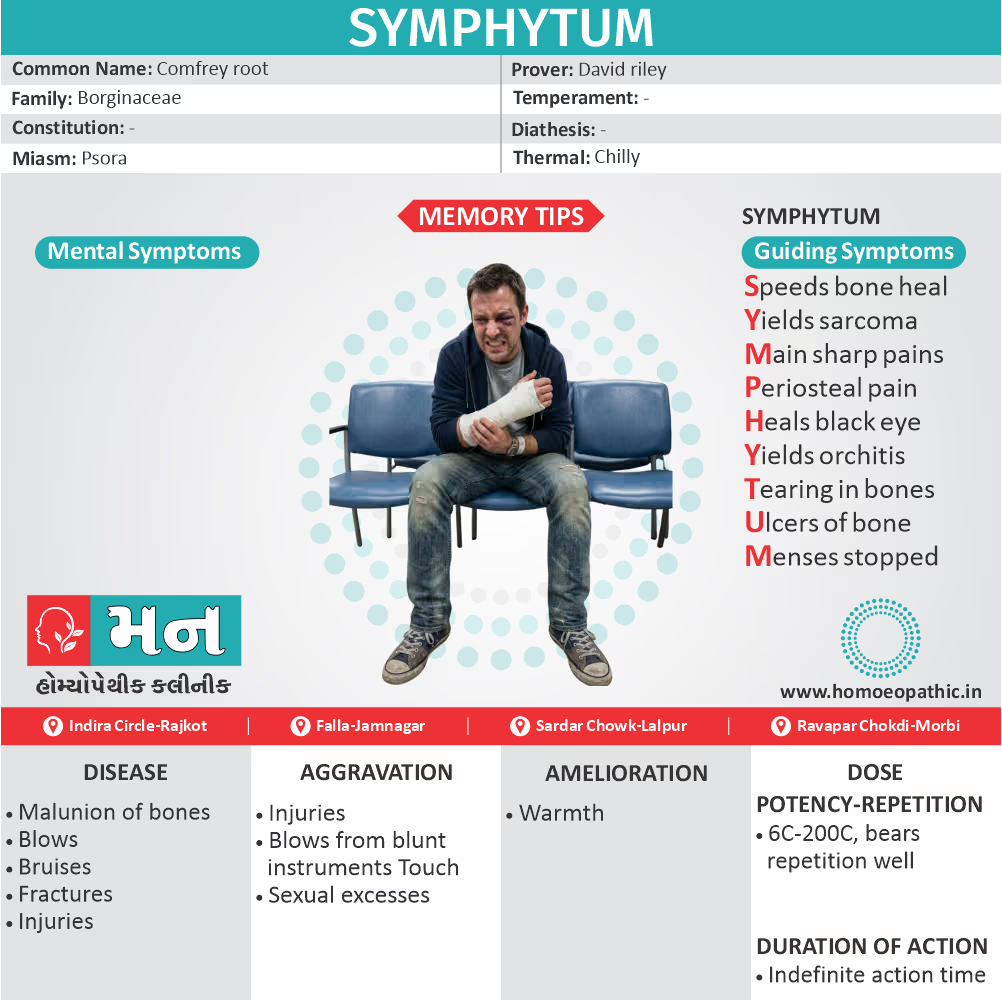
Hi Friends Let’s memorize guiding symptoms of Symphytum through name of Medicine ‘SYMPHYTUM’.
S
Y
M
P
H
Y
T
U
M
S
S – Speeds bone heal
Description: Symphytum, commonly known as ‘knit-bone’, is a premier remedy for fractures. It remarkably accelerates the healing process by promoting the formation of callus, the bony material that mends the break. It is particularly indicated when bones are slow to unite and helps to soothe the characteristic pricking pain at the site of the fracture.
Reference: Dr. William Boericke’s “Pocket Manual of Homoeopathic Materia Medica & Repertory”
Y
Y – Yields sarcoma
Description: Dr.M.L.Tyler notes a case in which a recurring sarcomatous tumor was relived by application of paultices of comfrey root.
Reference: Homoeopathic Drug Pictures By M.L.Tyler.
M
M- Main sharp pains
Description:Seems to act specially on the joints, a woman, 50, after single dose of complained of loss of power in the large joints, they seemed to get fixed, being particularly painful on turning in bed, and then followed great working in all the joints, especially in feet, with prickings and shootings in toes of both feet (R.T.C.).
Reference: Dictionary Of Practical Materia Medica (All 3 Vol.) By Clarke J. H.
P
P – Periosteal pain
Description: Symphytum is specific for injuries to the periosteum, the dense membrane that covers the bones. It is indicated for intense, sore, bruised pain following blows, falls, or other traumas, especially on thinly covered bones like the shins. The pain is often out of proportion to the injury and is worse from touch.
Reference: Nature’s Materia Medica By Robin Murphy, Md
H
H – Heals black eye
Description: It is a leading remedy for mechanical injuries to the eye and surrounding orbit from a blunt object, such as a punch or a thrown ball. Symphytum helps to absorb the extravasated blood that causes the ‘black eye’ and relieves the deep, aching pain within the eyeball itself.
Reference: Dr. John Henry Clarke’s “A Dictionary of Practical Materia Medica”
Y
Y – Yields orchitis
Description: Testicles become painful and tender, prevent walking. Backache from excessive sexual indulgence, with spermatorrhea.
Reference: Nature’s Materia Medica By Robin Murphy, Md
T
T – Tearing in bones
Description: The pains associated with Symphytum can have a distinct tearing quality. This sensation is often felt deep in the bone or in the periosteum and can be quite distressing for the patient. It points to significant irritation of the bone tissues following trauma.
Reference: Dr. C.M. Boger’s “A Synoptic Key of the Materia Medica”
U
U – Ulcers of bone
Description: Symphytum can be beneficial for the pain associated with ulcers that extend deep enough to affect the bone. It addresses the gnawing, scraping, or deep-seated pain that arises from such chronic and severe conditions, particularly if they originated from a past injury.
Reference: Dr. T.F. Allen’s “The Encyclopedia of Pure Materia Medica”
M
M – Menses stopped
Description: Menses stopped, headache, weight in forehead when she stoops, has it almost all time, a good deal of fever every other hour, cold all day, cramp and diarrhoea, nose sore inside alae, wants to pick it, wants to rub her eyes, inflamed ears, feels as if something were in them, stopped up, cannot hear well.
Reference: Dictionary Of Practical Materia Medica (All 3 Vol.) By Clarke J. H.
Introduction
Constitution
Clinical
Mental Symptoms
Guiding Symptoms
Characteristic
Therapeutic Value
Modality
Remedy Relationship
Dose
Terminologies
Reference
Also Search As
Introduction
Introduction of Symphytum
Common name:
Comfrey root[1]
Synonyms
Comfrey-Knitbone[2]
Family / Group / Class / Order
Boraginaceae
Habit and habitat / Description
Symphytum officinale, the plant source for the homeopathic remedy, is a robust perennial herb native to Europe and temperate parts of Asia. It thrives in damp, grassy habitats like riverbanks and meadows, adapting well to various soils, including heavy clay. The plant forms a dense clump, growing up to 1.5 meters tall from a thick, black taproot. It is characterized by its large, coarse, and hairy leaves and drooping clusters of bell-shaped flowers that bloom from late spring to summer, varying in color from creamy-yellow to pink and purple. Due to its vigorous and deep root system, it can be invasive but is also valued for its ability to accumulate nutrients, making its foliage an excellent compost activator.
Formula / Symbols
–
Name of prover
David riley
Introduction and history
Symphytum may be considered the orthopedic
specific of herbal medicine. According to Gerarde, ‘The roots of Comfrey
stamped, and the juice drunk with wine, help those that spit blood and heal all
inward wounds and burstings. The same bruised and laid to in manner of a plaster,
do heal all fresh and green wounds and are so glutinous, that it will solder and
glue together meat that is chopped in pieces.
Doctrine of signature
–
Parts used
Fresh roots
Active principles
–
Preparation
Tincture of fresh root – stock collected before
flowering and in autumn
Constitution
Constitution of Symphytum
Physical make up
No particular physical makeup.
Temperament
–
Diathesis
–
Relation with heat & cold
Chilly
Miasm
Psoric
Clinical
Clinical conditions of Symphytum
Abscess. Backache, from sexual excess. Bone, cancer of, injuries of. Breasts, sore. Eyes, pains in, injuries of. Fractures, non- union of, nervous. Glands, enlarged. Gunshot wounds. Hernia. Menses, arrested. Periosteum, sensitive, painful. Psoas abscess. Sexual excess, effects of. Sprains. Stump, irritable. Wounds. [3]
Sites of action / Pharmacodynamics
It mainly acts on bones, fibrous
tissues and joints.
Causation (Causes / Ailments from)
Fractures, injures to eyes, bone, periosteum; falls, blows,
sexual excesses.
Physiological action
–
Patho-physiological changes / Pathogenesis
The pathogenesis addressed by Symphytum involves a significant failure in the body’s natural healing cascade following an injury. Primarily, it centers on deficient osteogenesis, where the bone-building process stalls, leading to poor callus formation and the subsequent non-union of fractures. This state is accompanied by intense and persistent irritation of the periosteum (the bone’s covering), which causes the characteristic sharp, pricking pains. A similar mechanism of blunt force trauma causing deep pain and bruising applies to its well-known action on the eyeball.
Mental Symptoms
Characteristic Mental Symptoms (psychology) of Symphytum
Guiding Symptoms
Symphytum Guiding Symptoms
Generalities
The root contains a crystalline solid, that stimulates the growth of epithelium on ulcerated surfaces. It may be administered internally in the treatment of gastric and duodenal ulcers. Also in gastralgia, and externally in pruritus ani. Injuries to sinews, tendons and the periosteum. Acts on joints generally. Neuralgia of knee. Of great use in wounds penetrating to perineum and bones, AND IN NON-UNION OF FRACTURES; irritable stump after amputation, irritable bone at point of fracture. Psoas abscess. PRICKING PAIN and soreness of periosteum.[1]
Head
Headache in occiput, in top of head, in forehead, changing places.[3]
Eye
Pain in eyes after a knock or contusion of an opaque body. After being struck upon eye with a cane by a child, no visible injury, but a sensation on closing eye as if upper lid passed over an elevation on bulb of eye, on waking eye could not be easily opened, seemed spasmodically closed.
Ears
Cannot hear well, feels as if ears were stopped up. Inflamed ears.
Nose
Pain comes down bone of nose, and sometimes down both sides of nose (produced. R.T.C.).
Face
(Malignant tumour of right antrum.) Inflammation of inferior maxillary bone, hard, red swelling.
Stomach
Pains across epigastrium from one side to other, worse opposite spleen, in walking, when sitting worse about navel, griping pain.
Stool
(Dysentery. Inflamed and bleeding piles.).
Urinary Organ
Structure of urethra (curative in some forms. R.T.C.).
Sexual Organ
Testicles become painful and tender and prevent walking (produced. R.T.C.). (Backache from excessive sexual indulgence, with spermatorrhoea. Gerarde.).Menses stopped, headache, weight in forehead when she stoops, has it almost all time, a good deal of fever every other hour, cold all day, cramp and diarrhoea, nose sore inside alae, wants to pick it, wants to rub her eyes, inflamed ears, feels as if something were in them, stopped up, cannot hear well. (Leucorrhoea. Sore breasts.).
Neck & Back
Pain in back from a fall, from sexual excess. Pott’s disease from fall. Psoas abscess. Much used among herbalists in caries of spinal and other bones (R.T.C.).
Extremities
More than a year ago struck knee upon a stone, wound healed and left scarcely any trace, but there remained an acute stitching pain in the place, felt when clothing touched part, or when knee was bent. Man suffering from a spontaneous luxation of thigh since childhood, fell and received a fracture of affected thigh, after two months fragments were quite movable, and as union was despaired of, an apparatus was made which allowed him to sit on a chair during day, Symp. 4, four globules every six hours, brought about complete union in twenty days.
Characteristic
Important characteristic features of Symphytum
Keynotes / Redline
– For injuries to bones, cartilages; periosteum; with excessive pain. Stitches remaining in old injuries < touch.
– Fractures; non-union of bones.
– Blunt injuries to the eye.
Guiding
Non-Union of Fractures
Pain in Periosteum after Injury
Mechanical Injury to the Eyeball
Painful Old, Healed Fractures
Pricking, Stitching Pains at Injury Site[4]
PQRS
Irritable, Painful Stump after Amputation
Pain in Eyeball after being Struck by a Blunt Object
Failure to form Callus despite Proper Bone Setting
Threatened Miscarriage following a Blow or Fall
Intolerable Pain in the Shin Bone from a Kick
Nucleus symptoms
-Blunt injuries to the cartilages, periosteum, eye; with excessive stitching pain < touch.
-Deficient callus formation non-healing of bones.
Therapeutic Value
Therapeutic value of Symphytum
Blows, Bruises, Fractures, Injuries
Modality
Modality of Symphytum
Aggravation
Injuries
Blows from blunt instruments Touch
Sexual excesses.
Amelioration
Warmth
Remedy Relationship
Symphytum Remedy Relationship
Complimentary
Arn, Calc-p.
Follows Well
Arn
It Antidotes
Canth
Comparison
Arn, Calc-p, Calen, Fl-ac, Hep, Hyper, Led, Rhus-t, Sil, Staph
Dose
Dose of Symphytum
6 to 200c potency.Bears repetition well
Potency
–
Duration of Action
Indefinite duration of action.
Terminologies
Terminologies of Symphytum
Key Homeopathic Terms
Remedy:
A substance prepared through a specific homeopathic process of dilution and succession (vigorous shaking), intended to stimulate the body’s healing response.
Materia Medica:
A comprehensive encyclopedia or collection of information about homeopathic remedies. Each entry details the symptoms a substance is known to cause in healthy individuals, and therefore can cure in the sick. It’s organized by remedy name.
Repertory:
An index of symptoms. Unlike a Materia Medica, a repertory is organized by symptom (e.g., “headache, throbbing”), and under each symptom, it lists all the remedies known to address it, often graded by intensity.
Vital Force:
The inherent life energy that is believed to maintain the health and harmony of an individual. In homeopathy, illness is seen as a disturbance of this force, and remedies are meant to stimulate it to restore balance.
Keynote:
A unique, characteristic, or peculiar symptom that is highly indicative of a specific remedy. The symptom “pain in the periosteum after a blow” is a strong keynote for Symphytum.
Medical Terms in a Homeopathic Context
Callus:
The new, bony tissue that forms around the ends of a broken bone, which eventually hardens to complete the healing process. Symphytum is noted for promoting healthy callus formation.
Non-union / Malunion:
Non-union is the failure of a fractured bone to heal or knit together. Malunion is when a fractured bone heals in a deformed or incorrect position.
Periosteum:
The dense, fibrous membrane that covers the surface of bones. It is rich in nerves and blood vessels. Injury to this layer is a primary indication for Symphytum.
Extravasated Blood:
Blood that has leaked from a ruptured blood vessel into the surrounding tissues, causing discoloration (a bruise). Symphytum helps the body reabsorb this blood, especially in a “black eye.”
Reference
Reference of Symphytum
[1] Materia Medica By Boericke W.
[2] Gems textbook of materia medica by Dr.Patil
[3] Dictionary Of Practical Materia Medica (All 3 Vol.) By Clarke J. H.
[4] Zomeo
Also Search As
Also Search As of Symphytum
1. By General Remedy Name
This is for users who know the remedy’s name and want general information.
“symphytum homeopathy uses”
“symphytum materia medica”
“homeopathic medicine symphytum”
“symphytum benefits”
2. By Specific Ailment or Injury
This is the most common search method, used by people seeking a solution for a specific problem.
“homeopathic remedy for broken bones”
“symphytum for fractures”
“homeopathy for black eye injury”
“bone healing homeopathic medicine”
“remedy for periosteum pain”
3. By Asking Natural Language Questions
Users increasingly search by asking questions directly to search engines.
“What is symphytum used for in homeopathy?”
“How does symphytum help heal bones?”
“Can homeopathy treat a non-union fracture?”
“Which homeopathic medicine is for eye injury from a punch?”
4. By Common Name
Some users may know the remedy by its common plant name.
“comfrey homeopathic remedy”
“knitbone homeopathy uses”
5. For Practitioners and Students
These searches are more technical and often include the names of specific authors or reference books.
“symphytum keynotes”
“symphytum boericke materia medica”
“compare arnica ruta and symphytum”
“symphytum proving”
Frequently Asked Questions (FAQ)
What is Symphytum primarily used for?
Uses
Symphytum is a key homeopathic remedy for injuries to bones and the periosteum (the membrane covering bones). It’s most famous for accelerating the healing of fractures, mending bones that are slow to unite (non-union), and treating injuries to the eyeball.
Is Symphytum the same as Comfrey or Knitbone?
Yes. The homeopathic remedy Symphytum is derived from the plant Symphytum officinale, which is commonly known as Comfrey or Knitbone due to its traditional use in healing broken bones.
How does Symphytum help heal broken bones?
Mechanism
Symphytum is believed to stimulate the body’s natural healing mechanisms, specifically the production of callus—the bony material that mends a fracture. This action helps to speed up the union of broken bones and can reduce the associated sharp, pricking pain.
Can Symphytum be used for a black eye?
Black eye
Absolutely. Symphytum is a top remedy for a black eye resulting from a direct, blunt impact (like a punch or being hit by a ball). It addresses the pain within the eyeball itself and the bruising around the orbit.
What is the difference between using Arnica and Symphytum for an injury?
Difference
Think of them as a sequence. Arnica montana is typically used first for the initial shock, trauma, swelling, and soft-tissue bruising of an injury. Symphytum is used afterward, or when the injury is specifically to the bone, periosteum, or eyeball, to promote deeper structural healing.
Does Symphytum help with dental issues?
Dental Issue
Yes, it can be useful for pain after an injury to the jawbone or teeth, such as from a blow or following a dental procedure. It is particularly helpful for pain in the bone socket after a tooth extraction.
Beyond fresh fractures, can Symphytum help with old bone injuries?
Old bone injury
Absolutely. In fact, Symphytum shows remarkable effectiveness for old, painful injuries that have never fully healed. Furthermore, it actively soothes the pricking, sore pain that often lingers in old fracture sites long after the initial trauma has passed.
What specific type of pain indicates a need for Symphytum?
Pain
Symphytum specifically targets a deep, sore, aching, or pricking pain located directly in the bone or its sensitive covering, the periosteum. Consequently, if an injury feels intensely sore to the touch right on the bone itself, practitioners often consider Symphytum the indicated remedy.
Can Symphytum provide relief for pain after an amputation?
Fantom pain
Yes, this is a unique and important application of the remedy. Homeopaths frequently use Symphytum to soothe the persistent pain in the stump of an amputated limb, particularly for an “irritable stump” that remains sensitive to touch. Moreover, it can help with the sensation of pain felt in the bone of the amputated part.
Uses
Symphytum is a key homeopathic remedy for injuries to bones and the periosteum (the membrane covering bones). It’s most famous for accelerating the healing of fractures, mending bones that are slow to unite (non-union), and treating injuries to the eyeball.
Yes. The homeopathic remedy Symphytum is derived from the plant Symphytum officinale, which is commonly known as Comfrey or Knitbone due to its traditional use in healing broken bones.
Mechanism
Symphytum is believed to stimulate the body’s natural healing mechanisms, specifically the production of callus—the bony material that mends a fracture. This action helps to speed up the union of broken bones and can reduce the associated sharp, pricking pain.
Black eye
Absolutely. Symphytum is a top remedy for a black eye resulting from a direct, blunt impact (like a punch or being hit by a ball). It addresses the pain within the eyeball itself and the bruising around the orbit.
Difference
Think of them as a sequence. Arnica montana is typically used first for the initial shock, trauma, swelling, and soft-tissue bruising of an injury. Symphytum is used afterward, or when the injury is specifically to the bone, periosteum, or eyeball, to promote deeper structural healing.
Dental Issue
Yes, it can be useful for pain after an injury to the jawbone or teeth, such as from a blow or following a dental procedure. It is particularly helpful for pain in the bone socket after a tooth extraction.
Old bone injury
Absolutely. In fact, Symphytum shows remarkable effectiveness for old, painful injuries that have never fully healed. Furthermore, it actively soothes the pricking, sore pain that often lingers in old fracture sites long after the initial trauma has passed.
Pain
Symphytum specifically targets a deep, sore, aching, or pricking pain located directly in the bone or its sensitive covering, the periosteum. Consequently, if an injury feels intensely sore to the touch right on the bone itself, practitioners often consider Symphytum the indicated remedy.
Fantom pain
Yes, this is a unique and important application of the remedy. Homeopaths frequently use Symphytum to soothe the persistent pain in the stump of an amputated limb, particularly for an “irritable stump” that remains sensitive to touch. Moreover, it can help with the sensation of pain felt in the bone of the amputated part.