Hamamelis Virginica
Overview:
The deep red of the tincture of Hamamelis Virginica may be taken as the ‘doctrine of signature’ of its therapeutic action.
Dr C. Hering who learned its properties from Mr Pond of ‘Pond’s Extract’ fame
(Pond was a patient of Hering), made the first proving and introduced the remedy into homeopathy.
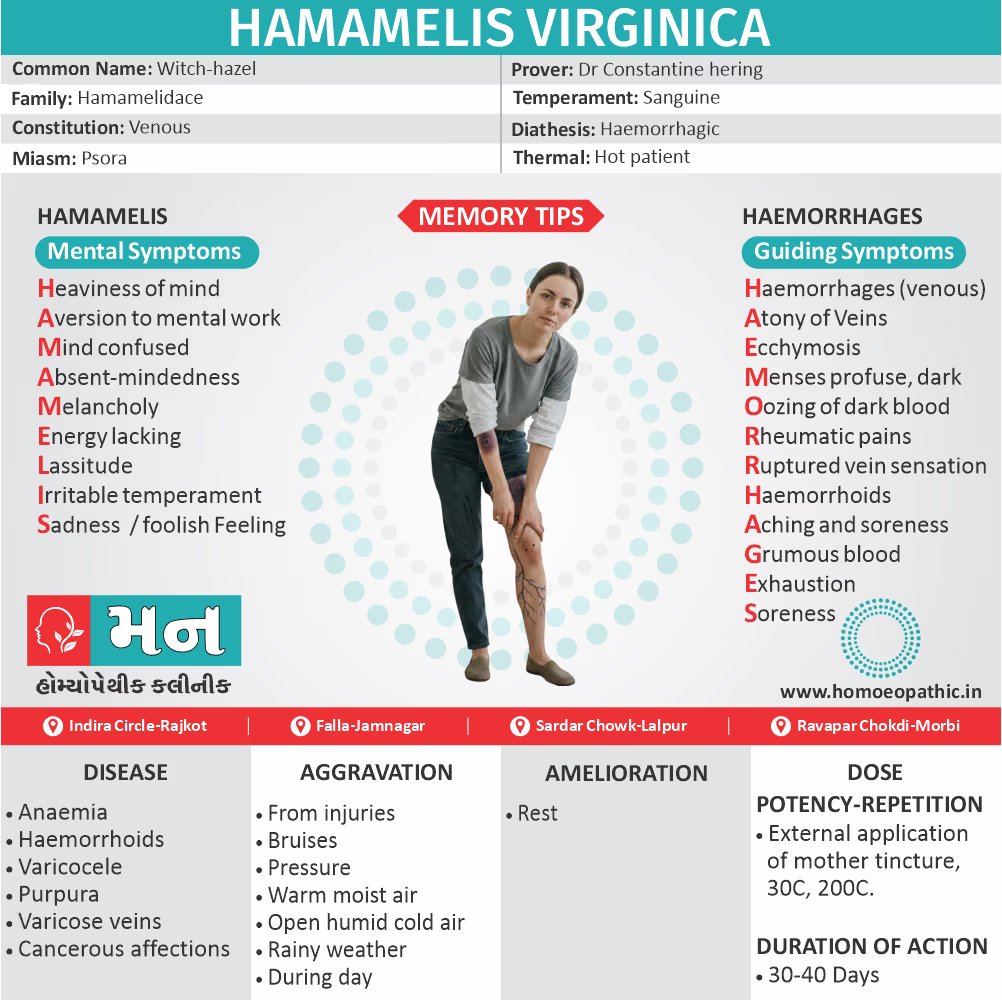
Memory Tips for Mental Symptoms
Hi Friends Let’s memorize guiding symptoms of Hamamelis Virginica through name of Medicine ‘Hamamelis Virginica’.
H
A
M
A
M
E
L
I
S
H
H – Heaviness of Mind / Headache with Mental Depression
Description:
Dulness and fulness in head all day.
Headache after an emission ; depressed in mind. [4]
References:
Hering, C. – The Guiding Symptoms of Our Materia Medica.
A
A – Aversion to Mental Work / No Desire to Study
Description:
No desire to study or work ; ideas confused, could not compose. [4]
The patient is tired, mentally and physically; aversion to mental work [3]
References:
Hering, C. – The Guiding Symptoms of Our Materia Medica.
Kent, J.T. – Lectures on Homoeopathic Materia Medica.
M
M – Mind Confused / Muddled Thinking
Description:
Ideas confused, could not compose. [4]
References:
Hering, C. – The Guiding Symptoms of Our Materia Medica.
A
A – Absent-mindedness / Forgetfulness
Description:
Forgetful, especially of words when talking. [4]
References:
Hering, C. – The Guiding Symptoms of Our Materia Medica.
M
M – Melancholy / Gloomy Disposition / Mind, Regretful
Description:
Gloomy…” (from “Irritable ; gloomy ; depressed ; foolish.”)
Regretful mind.” (from “Depressed in mind ; also after emissions, with regretful mind.[4]
References:
Hering, C. – The Guiding Symptoms of Our Materia Medica.
E
E – Energy Lacking (for Mental Tasks) / Exhaustion
Description:
No desire to study or work…” (This implies a lack of mental energy or a state of mental exhaustion regarding tasks) [4]
The patient is tired, mentally and physically [3]
References:
Hering, C. – The Guiding Symptoms of Our Materia Medica.
Kent, J.T. – Lectures on Homoeopathic Materia Medica.
L
L – Lassitude / Listlessness (Mental)
Description:
No desire to study or work [4]
References:
Hering, C. – The Guiding Symptoms of Our Materia Medica.
I
I – Irritable Temperament
Description:
Irritable ; gloomy ; depressed ; foolish. [4]
Irritable, depressed and foolish, with recurrent hemorrhages.[1]
References:
Hering, C. – The Guiding Symptoms of Our Materia Medica.
Kent, J.T. – Lectures on Homoeopathic Materia Medica.
S
S – Sadness / Foolish Feeling (Depressed State)
Description:
Depressed ; foolish.” (The term “foolish” here implies a mental dullness or torpor, while “depressed” covers the sadness).
Depressed in mind. [4]
References:
Hering, C. – The Guiding Symptoms of Our Materia Medica.
Memory Tips for Guiding Symptoms
Hi Friends Let’s memorize Guiding symptoms of Hamamelis Virginica through word related to medicine “Haemorrhages”
H
A
E
M
O
R
R
H
A
G
E
S
H
H – Haemorrhages (Venous)
Description:
Venous haemorrhage from every orifice of the body; nose, lungs, bowels, uterus, bladder.
References:
Kent, J.T. – Lectures on Homoeopathic Materia Medica
A
A – Atony of Veins / Affected Parts Sore
Description:
It acts upon the coats of the veins causing relaxation with consequent engorgement.[2]
Bruised soreness of affected parts. [3]
Reference:
Boericke, W. – Pocket Manual of Homoeopathic Materia Medica and Repertory.
Allen, H.C. – Keynotes and Characteristics with Comparisons of some of the Leading Remedies of the Materia Medica. (Often quoted alongside Arnica for this symptom).
E
E – Ecchymosis / Epistaxis
Description:
Ecchymosis with extreme tenderness of head, eyes or face. [4]
Epistaxis, flow passive, non-coagulable. [5]
Reference:
Hering, C. – The Guiding Symptoms of Our Materia Medica. (Under “Outer Head” or “Sight and Eyes
Nash, E.B. – Leaders in Homoeopathic Therapeutics.
M
M – Menses (Profuse, Dark) / Melancholy
Description:
Menses: flow, dark and profuse; with soreness in abdomen; after a blow on ovary, or a fall; all suffering < at menstrual period. [3]
Depressed in mind ; also after emissions, with regretful mind. [4]
Reference:
Allen, H.C. – Keynotes and Characteristics with Comparisons of some of the Leading Remedies of the Materia Medica.
Hering, C. – The Guiding Symptoms of Our Materia Medica. (Under “Mind”)
O
O – Oozing of Dark, Non-Coagulable Blood / Ovarian Region Soreness
Description:
Dark blood flows from any part. Bright red fluid blood is the exception, but has been recorded.
Tenderness in ovaries and uterus.” “Paroxysmal pain in left ovary. [1]
Reference:
Kent, J.T. – Lectures on Homoeopathic Materia Medica. (Implies dark, often slowly oozing venous blood).
R
R – Rheumatic Pains / Rawness and Soreness
Description:
Rheumatism, articular and muscular.
Anus feels sore and raw. [3]
References:
Allen, H.C. – Keynotes and Characteristics with Comparisons of some of the Leading Remedies of the Materia Medica.
R
R – Ruptured Vein Sensation / Rough Riding Aggravation
Description:
Uterine haemorrhage active or passive; from jolting while riding over rough roads; bearing down pain in back. [3]
references:
Allen, H.C. – Keynotes and Characteristics with Comparisons of some of the Leading Remedies of the Materia Medica.
H
H – Haemorrhoids
Description:
Hæmorrhoids; bleeding profusely; with burning, soreness, fullness, heaviness; as if back would break; urging to stool; bluish color; anus feels sore and raw. [3]
References:
Allen, H.C. – Keynotes and Characteristics with Comparisons of some of the Leading Remedies of the Materia Medica.
A
A – Aching and Soreness in Limbs (with Varices)
Description:
Aching bruised feeling in thighs.” “Soreness in veins of thighs and legs. [1]
References:
Kent, J.T. – Lectures on Homoeopathic Materia Medica. (Under “Lower Limbs”)
G
G – Grumous Blood
Description:
Haemorrhage: profuse, dark, grumous, from ulceration of bowels (Crot.). [3]
References:
Allen, H.C. – Keynotes and Characteristics with Comparisons of some of the Leading Remedies of the Materia Medica. (Grumous means thick, clotted, or lumpy).
E
E – Exhaustion (from Haemorrhage or Pain)
Description:
Much weakness with or without bleeding: out of proportion to the loss of blood. [1]
References:
Kent, J.T. – Lectures on Homoeopathic Materia Medica.
S
S – Soreness (Bruised Soreness)
Description:
BRUISED SORENESS OF AFFECTED PARTS (Am.); rheumatism, articular and muscular. [3]
References:
Allen, H.C. – Keynotes and Characteristics with Comparisons of some of the Leading Remedies of the Materia Medica.
Introduction
Constitution
Clinical
Mental Symptoms
Guiding Symptoms
Characteristic
Therapeutic Value
Modality
Remedy Relationship
Dose
Terminology
Reference
Also Search As
Introduction
Common name:
Witch-hazel [6]
Synonyms:
Witch-hazel [6]
Family / Group / Class / Order:
Hamamelidace [6]
Habit and habitat / Description:
USA. The shrub flowers from September to November.
When the leaves are falling, the shrub flowers.
The seeds mature the following summer.
Name of prover:
Dr Constantine Hering [6]
Introduction and history:
The deep red of the tincture of Hamamelis may be taken as the ‘doctrine of signature’ of its therapeutic action.
No remedy has a wider sphere of usefulness in cases of haemorrhages and disordered blood vessels. [1]
Doctrine of signature:
Hemorrhages:
Hamamelis is a cornerstone homeopathic remedy for various types of bleeding, especially venous hemorrhages that are dark, passive, and non-coagulable.
This includes nosebleeds, bleeding gums, bleeding hemorrhoids, and uterine hemorrhage. [6]
Bruising and Soreness:
Hamamelis is well-indicated for bruises and traumatic injuries where there is soreness and a bruised feeling, reflecting its action on blood extravasation and tissue repair. [6]
Parts used:
The tincture is prepared from the fresh bark of twigs and roots. [6]
Preparation:
The tincture is prepared from the fresh bark of twigs and roots. [6]
Constitution
Physical make up:
It is suited to venous constitutions. [6]
Temperament:
Sanguine [6]
Diathesis:
Haemorrhagic [6]
Relation with heat & cold:
Hot [2]
Miasm:
Psora [6]
Clinical
Clinical conditions:
Anaemia, Haemorrhoids, Orchitis, Varicocele, Purpura, Varicose veins, Milk leg, Open wounds, which are bleeding, Burns, Bruises, Threatened abortion,Hematemesis, Epistaxis, Hematuria, Menorrhagia, Phlebitis, MILK LEG, Cancerous affections, External dropsy, Portal stasis, Pylestasis, Scurvy, Scorbutus, Apoplexy of retina, Traumatic and granular conjunctivitis, Ulceration of conjunctiva, Vascular goitre, Injuries of pelvic organs, Acute hematocele, Inflammatory hydrocele, Inflammation of scrotum, epididymis, Phimosis, Haematocele, pelvic, Tuberculosis of lungs, METRORRHAGIA. [7]
Sites of action / Pharmacodynamics:
It mainly acts on veins, capillaries,
liver, portal system, rectum and reproductive organs. [6]
Causation (Causes / Ailments from):
Burns, injuries. [6]
Physiological action:
Useful for incised, lacerated, contused injuries from falls. It stops
the haemorrhage and removes soreness and pain.
Bruised soreness of affected parts, articular and muscular rheumatism
These bleed profusely with burning, soreness, fullness, heaviness, as if the back would break, urging to stool.
Stools are bluish; anus feel raw and sore to touch. [6]
Patho-physiological changes / Pathogenesis
Through the spinal nerves it acts upon the venous system and upon the generative organs of people of all genders
It acts on the venous system producing venous congestion, varicosis and haemorrhage.
It acts on the generative organs of women where it produces great irritation, congestion, inflammation and neuralgia of the ovaries, passive haemorrhage from the uterus and irritation of the venous capillaries of the mucous membrane of the vagina and uterus. [6]
Mental Symptoms
Characteristic Mental Symptoms (psychology)
Forgetful.
No desire to study or work.
Depressed in mind; also after emissions, with regretful mind.
Irritable. [4]
Wants “the respect due to me” shown.
Comprehension easy.
Conversation desire for, sublime to hear.
Dreams of bat flying in room causing fear.
Dreams unpleasant.
Fear of bats.
Ideas abundant, clearness of mind morning after restless sleep.
Thoughts clear, perception of anything shape or disproportion. [7]
Guiding Symptoms
Generalities:
Venous congestion, haemorrhages, varicose veins, and haemorrhoids, with BRUISED SORENESS OF AFFECTED PARTS, seem to be the special sphere of this remedy.
Acts upon the coats of the veins causing relaxation with consequent engorgement. Passive venous haemorrhages from any part.
Great value in open, painful wounds, with weakness from loss of blood. After operations, supercedes the use of morphia (Helmuth). [2]
Head:
Wants “the respect due to me” shown. Feeling as of a bolt from temple to temple.
Fullness, followed by epistaxis. Numbness over frontal bone. [2]
Eye:
Painful weakness; SORE PAIN in eyes; bloodshot appearance; inflamed vessels greatly injected.
Hastens absorption of intraocular haemorrhage. Eyes feel forced out. [2]
Ears:
Deafness in right ear, passes off by noon. Buzzing, ringing in ears. Bleeding at right ear, also nosebleed, which clears her head, relieving her. [8]
Nose:
Over-sensitive sense of smell. Bad smell from the nose. Nose feels stopped up. Sneezing spells, watery, excoriating, burning discharge.
Nosebleeds, flow passive, non-coagulable, with tightness at the bridge of the nose. Profuse nosebleed, idiopathic or vicarious.
Nosebleeds with hemiplegia in old men. The nosebleed clears head and relieves. [8]
Face:
Burning in right cheek. Muscles feel sore and stiff. Occasional shooting pains along right superior maxillary to malar bone. Lips are dry, sore, cracked. [8]
Mouth:
Gums swollen.
Bleed easily (Merc., Nitr. ac.).
Passive, venous haemorrhage after extraction of teeth. (Ars.). [9]
Throat:
Tonsils and fauces congested; veins enlarged, varicose.[9]
Stomach:
Haematemesis of black blood; tremulous, weak, cold, quick pulse, profuse sweats (Ars.). [9]
Abdomen:
Cramps in stomach and transverse colon two hours after a hearty dinner.
Flatulence.
Burning in the epigastrium and umbilicus. [4]
Rectum & Anus:
Stools; costive; hard, coated with mucus.
Dysentery when the amount of blood is unusually large; dark, small clots, or patches through the mucus.
Piles bleeding profusely with burning soreness, fullness and weight; back as if it would break; urging to stool.
Large quantities of a tar-like blood. Typhoid.
Itching at the anus. [4]
Urinary Organ:
Increased desire to urinate.
Urine clear copious.
Scanty high-colored urine.
Haematuria passive congestion of the kidneys; dull pain in renal region.
Irritation of the urethra, followed by a discharge and ardor urinae or burning pain during micturition. [4]
Sexual Organ:
MALE SEXUAL ORGANS
Emissions at night, without being aware of it headache, depression of mind.
Erections great desire for an embrace.
Severe neuralgic pains in testicles suddenly shifting to bowels, causing nausea and faintness; profuse cold sweat on scrotum; capillary stasis. [4]
FEMALE SEXUAL ORGANS
Dysmenorrhoea, with severe pains through the lumbar and hypogastric regions and down the legs; fullness of the brain and bowels with severe pain through the whole head, causing stupor deep; varicose veins.
Metrorrhagia, passive flow; anaemia.
Amenorrhoea, vicarious bleeding from nose or stomach costive varices on the legs.
Leucorrhoea great tenderness of the vagina; flow bloody.
Vaginismus intense soreness; prurigo of vulva.
Ovaritis after a blow; diffused agonizing soreness over the whole abdomen; menses irregular worse at time of menses retention of urine. [4]
Respiratory System:
Haemoptysis; acute or passive blood, venous and comes up into the mouth without coughing, or scarcely any effort is required to hawk it up; with a sensation of trembling in stomach, or fullness in abdomen.
Blood-spitting with weak, cold, quick pulse and copious perspiration and stitches in lower parts of lungs.
Tickling cough with taste of blood or sulphur, with blood- shot eyes, constipation in chest and inability to lie down. [2]
Heart & Pulse:
Pulse accelerated, full. Palpitations. Pricking pain in region of heart and superficial veins of both arms. [8]
Neck & Back:
Sore pain down cervical vertebrae.
Fullness in neck; had to sleep with neck free of any covering.
Small of back feels as if it would break; tearing pains.
After sensation of heat, tearing pains across small of back, with fullness of joints of legs, extending to all parts of body.
Severe headache all day, after an emission.
Dull, dragging pain in lumbar region.
Severe pains in lumbar and hypogastric regions, extending down legs. [4]
Extremities:
Tired feeling in arms and legs. Very sore muscles and joints. Varicose veins.
Chilliness in back and hips, extending down legs. Neuralgia of internal saphenous nerve. [4]
Skin:
Bluish chilblains. Phlebitis. Purpura. Varicose veins and ulcers; very sore.
Burns. Ecchymosis. Traumatic inflammations. [ARNICA.]. [2]
Sleep:
Restlessness at night. Uneasy, restless morning sleep. Emissions of semen during sleep. [8]
Fever:
Chilliness in back and hips extending down legs; worse in open air. [2]
Characteristic
Important characteristic features
Keynotes / Redline:
HAEMORRHOIDS, BLEEDING PROFUSELY, WITH SORENESS.
MENSES DARK, PROFUSE, WITH SORENESS IN ABDOMEN. METRORRHAGIA, OCCURRING MIDWAY BETWEEN MENSTRUAL PERIODS.
WEARINESS ON RISING, WITH VERTIGO; WORSE WHEN STANDING; WHEN WALKING; DESIRE TO LIE DOWN.
Distension of blood vessels.
Aversion to thinking of water.
Varicose veins distended, engorged during pregnancy.
PAIN PRESSING FROM WITHIN OUTWARDS AND SORE BRUISED EXTERNALLY. [7]
Guiding:
Useful for incised, lacerated, contused injuries from falls. It stops
the haemorrhage and removes soreness and pain.
Bruised soreness of affected parts, articular and muscular rheumatism
Passive, profuse, long lasting, non-coagulable flow of blood in
between menses, during childhood, in idiopathic cases and traumatic cases.
Severe prostration occurs after haemorrhage, out of all proportion to blood loss; due to haemorrhage from piles.
Flow is dark and profuse with soreness in the abdomen after a blow on the ovary or a fall, worse during menstruation. [6]
PQRS:
It acts upon the coats of the veins causing relaxation with consequent engorgement.
Causes passive venous haemorrhages from any part.
Acts on male & female genital organs causing inflammation and neuralgias. [7]
Nucleus symptoms:
It produces passive haemorrhages.
VENOUS CONGESTION, HAEMORRHAGES, VARICOSE VEINS, AND HAEMORRHOIDS, WITH BRUISED SORENESS OF AFFECTED PARTS, IS THE SPECIAL SPHERE OF THIS REMEDY.
Great value in open, painful wounds, with weakness from loss of blood after operations.
More exhaustion in contrast to the discharge of the blood.
Injuries with extravasations
Injuries from blows, cuts, lacerations, operations.
Tendency for miscarriages, threatening abortions.[7]
Therapeutic Value
Therapeutic Value
Bruises, Burns, Cancer, Chilblains, Enteric fever, Epistaxis, Gastric ulcers, Haematemesis, Haematuria, Haemorrhages,
Haemorrhoids, Leucorrhoea, Orchitis, Phimosis, Phlegmasia alba dolens, Purpura haemorrhagica, Rheumatism, Scurvy, Smallpox, Tuberculosis,
Varicocele, Varicose veins, Wounds. [6]
Modality
Modality
Aggravation:
From injuries, bruises, pressure, warm moist air, open humid cold
air, jar, touch, during day, rainy weather. [6]
Amelioration:
Rest [6]
Remedy Relationship
Complimentary:
Ferr. [7]
Follows Well:
Ferr.met, China, Arnica, Belis Pernesis, Puls. [7]
Antidoted By:
Arn, Camph, Chin, Puls. [7]
Comparison:
Aesc, Arn, Bov, Calen, Chlol, Clem-vit, Coll, Erig, Galium, Lycps, Senec, Sul-ac, Tril. [7]
Dose
Doses:
Dose:
External application of mother tincture. [7]
Potency:
Mother tincture to 3c. [7]
Duration of Action:
30 to 40 days [7]
Terminology
Terminology:
Terminologies and Their Meanings in the Article “Hamamelis Virginica”
Here are explanations for various terms used throughout your detailed article on Hamamelis Virginica:
General Homeopathic & Medical Terms:
Tincture (Mother Tincture / Q):
- Meaning: An person with alcohol use disorder or hydro-alcoholic solution containing the original medicinal substances extracted from a plant (like Hamamelis bark/twigs), animal product, or mineral. In homeopathy, the mother tincture (often denoted as ‘Q’) is the starting point for creating potentized remedies.
- Usage in article: “The deep red of the tincture of Hamamelis Virginica…”, “External application of mother tincture.”, “Mother tincture to 3c.”
Doctrine of Signature:
- Meaning: An old belief, sometimes considered in traditional medicine, that the physical appearance of a plant (color, shape, etc.) indicates its medicinal use.
- Usage in article: “The deep red of the tincture of Hamamelis Virginica may be taken as the ‘doctrine of signature’ of its therapeutic action.”
Proving (Homeopathic Proving):
- Meaning: A systematic process in homeopathy where a substance is administered to healthy volunteers (provers) to observe and record the symptoms it produces. These recorded symptoms form the basis of the remedy’s profile in the Materia Medica.
- Usage in article: “…made the first proving and introduced the remedy into homeopathy.”
Homeopathy:
- Meaning: A system of alternative medicine based on the principle of “like cures like” (Similia Similibus Curentur), where a substance that causes symptoms in a healthy person is used in diluted and potentized form to treat similar symptoms in a sick person.
- Usage in article: “…introduced the remedy into homeopathy.” (and implied throughout)
Materia Medica:
- Meaning: A collection of information about homeopathic remedies. It details the source, preparation, symptoms observed during provings, clinical uses, and relationships of each remedy.
- Usage in article: (Implied by the detailed description of symptoms and references to Hering, Kent, Allen, Boericke which are authors of renowned Materia Medicas). Also “Nature’s Materia Medica By Robin Murphy, Md”, “A Text Book Of Materia Medica And Therapeutics By A.W. Cowperthwaite.”
Keynotes / Redline Symptoms:
- Meaning: The most characteristic, peculiar, or frequently verified symptoms of a homeopathic remedy that are considered highly important for its selection. “Redline” symptoms are often considered very strong indicators.
- Usage in article: “Keynotes / Redline:”, “Allen, H.C. – Keynotes and Characteristics…”
Pocket Manual:
- Meaning: A concise handbook, often referring to Boericke’s “Pocket Manual of Homoeopathic Materia Medica and Repertory,” which is a quick reference guide for homeopaths.
- Usage in article: “Boericke, W. – Pocket Manual of Homoeopathic Materia Medica and Repertory.”
Ecchymosis:
- Meaning: A discoloration of the skin resulting from bleeding underneath, typically caused by bruising. A medical term for a bruise.
- Usage in article: “Ecchymosis with extreme tenderness…”, “Ecchymosis. Traumatic inflammations.”
Epistaxis:
- Meaning: Bleeding from the nose; a nosebleed.
- Usage in article: “Epistaxis, flow passive, non-coagulable.”, “…followed by epistaxis.”
Grumous:
- Meaning: Thick, clotted, or lumpy, often used to describe the consistency of blood.
- Usage in article: “Haemorrhage: profuse, dark, grumous…”
Haemorrhages:
- Meaning: Bleeding, especially profuse bleeding, from any part of the body.
- Usage in article: (Used extensively throughout, e.g., “Venous haemorrhage from every orifice…”)
Atony:
- Meaning: Lack of normal muscle tone or strength. “Atony of veins” implies veins that are relaxed and unable to contract effectively.
- Usage in article: “Atony of Veins…”
Menses:
- Meaning: The monthly menstrual flow in women.
- Usage in article: “Menses: flow, dark and profuse…”
Ovarian Region:
- Meaning: The area of the body where the ovaries are located, typically in the lower abdomen on either side of the uterus.
- Usage in article: “Ovarian Region Soreness”
Rheumatic Pains:
- Meaning: Pains affecting the joints, muscles, or fibrous tissues, characteristic of conditions like rheumatism.
- Usage in article: “Rheumatism, articular and muscular.”
Haemorrhoids (Piles):
- Meaning: Swollen and inflamed veins in the rectum and anus that can cause discomfort, pain, and bleeding.
- Usage in article: (Used extensively, e.g., “Hæmorrhoids; bleeding profusely…”)
Varices / Varicose Veins:
- Meaning: Abnormally swollen, twisted veins, especially in the legs, caused by weakened vein walls and faulty valves.
- Usage in article: “Aching and Soreness in Limbs (with Varices)”, “Varicose veins…”
Orchitis:
- Meaning: Inflammation of one or both testicles.
- Usage in article: (Listed under “Clinical conditions”)
Varicocele:
- Meaning: An enlargement of the veins within the scrotum, the loose bag of skin that holds the testicles.
- Usage in article: (Listed under “Clinical conditions”)
Purpura:
- Meaning: A condition characterized by purple or brownish-red spots on the skin or mucous membranes, caused by bleeding from small blood vessels.
- Usage in article: (Listed under “Clinical conditions”) “Purpura. Varicose veins and ulcers…”
Phlebitis:
- Meaning: Inflammation of a vein, usually in the legs.
- Usage in article: (Listed under “Clinical conditions”) “Phlebitis. Purpura.”
Threatened Abortion:
- Meaning: Symptoms such as vaginal bleeding or cramping that suggest a miscarriage (abortion) might occur.
- Usage in article: (Listed under “Clinical conditions”)
Hematemesis / Haematemesis:
- Meaning: Vomiting of blood.
- Usage in article: “Hematemesis”, “Haematemesis of black blood…”
Hematuria / Haematuria:
- Meaning: The presence of blood in the urine.
- Usage in article: “Hematuria”, “Haematuria passive congestion of the kidneys…”
- Meaning: Abnormally heavy or prolonged menstrual bleeding.
- Usage in article: (Listed under “Clinical conditions”)
Metrorrhagia:
- Meaning: Uterine bleeding at irregular intervals, particularly between the expected menstrual periods.
- Usage in article: “METRORRHAGIA.”, “Metrorrhagia, passive flow…”
Portal Stasis / Pylestasis:
- Meaning: Stagnation or slowing of blood flow in the portal venous system (which drains blood from the digestive organs to the liver). “Pylestasis” is a related term.
- Usage in article: “Portal stasis, Pylestasis”
Scorbutus (Scurvy):
- Meaning: A disease caused by a deficiency of vitamin C, characterized by swollen bleeding gums and the opening of previously healed1 wounds.
- Usage in article: “Scurvy, Scorbutus”
Apoplexy of Retina:
- Meaning: A sudden loss of function or bleeding within the retina of the eye.
- Usage in article: “Apoplexy of retina”
- Meaning: Inflammation of the conjunctiva, the thin clear tissue that lies over the white part of the eye and lines the inside of the2 eyelid.
- Usage in article: “Traumatic and granular conjunctivitis, Ulceration of conjunctiva”
Hematocele / Haematocele:
- Meaning: A collection of blood in a body cavity, especially within the scrotum or pelvis.
- Usage in article: “Acute hematocele, Inflammatory hydrocele”, “Haematocele, pelvic”
- Meaning: A collection of fluid in a sac-like cavity, especially in the scrotum.
- Usage in article: “Inflammatory hydrocele”
Epididymis:
- Meaning: A coiled tube located at the back of the testicle that stores and carries sperm.
- Usage in article: “Inflammation of scrotum, epididymis”
Phimosis:
- Meaning: A condition in which the foreskin of the penis is too tight to be pulled back over the glans.
- Usage in article: (Listed under “Clinical conditions”)
Haemoptysis:
- Meaning: Coughing up blood from the lungs or respiratory tract.
- Usage in article: “Haemoptysis; acute or passive blood…”
Dysentery:
- Meaning: An infection of the intestines resulting in severe diarrhea with the presence of blood and mucus in the feces.
- Usage in article: “Dysentery when the amount of blood is unusually large…”
Ardor Urinae:
- Meaning: A burning sensation during urination.
- Usage in article: “…ardor urinae or burning pain during micturition.”
Neuralgic Pains / Neuralgia:
- Meaning: Sharp, shocking pain that follows the path of a nerve due to irritation or damage to the nerve.
- Usage in article: “Severe neuralgic pains in testicles…”
Capillary Stasis:
- Meaning: Stagnation or slowing of blood flow in the capillaries (the smallest blood vessels).
- Usage in article: “…profuse cold sweat on scrotum; capillary stasis.”
Dysmenorrhoea:
- Meaning: Painful menstrual periods.
- Usage in article: “Dysmenorrhoea, with severe pains…”
Amenorrhoea:
- Meaning: The absence of menstruation.
- Usage in article: “Amenorrhoea, vicarious bleeding…”
Vicarious Bleeding:
- Meaning: Bleeding from a site other than the uterus during the time of menstruation (e.g., nosebleed).
- Usage in article: “…vicarious bleeding from nose or stomach…”
Leucorrhoea:
- Meaning: A whitish or yellowish discharge of mucus from the vagina.
- Usage in article: “Leucorrhoea great tenderness of the vagina…”
Vaginismus:
- Meaning: Involuntary spasm of the muscles surrounding the vagina, causing pain and difficulty with intercourse or vaginal examination.
- Usage in article: “Vaginismus intense soreness…”
Prurigo (Pruritus of Vulva):
- Meaning: Prurigo refers to intensely itchy eruptions on the skin. Pruritus of the vulva means itching of the external female genitals.
- Usage in article: “…prurigo of vulva.”
Ovaritis:
- Meaning: Inflammation of an ovary.
- Usage in article: “Ovaritis after a blow…”
Palpitations:
- Meaning: A noticeably rapid, strong, or irregular heartbeat due to agitation, exertion, or illness.
- Usage in article: “Palpitations.”
Chilblains:
- Meaning: Painful inflammation of small blood vessels in the skin that occur in response to repeated exposure to cold but not freezing3 air.
- Usage in article: “Bluish chilblains.”
Phlegmasia Alba Dolens (Milk Leg):
- Meaning: A painful swelling of the leg, typically in postpartum women, caused by deep vein thrombosis (blood clot). “Milk leg” is a common term.
- Usage in article: “MILK LEG”, “Phlegmasia alba dolens”
Terms Related to Homeopathic Philosophy & Practice:
Constitution:
- Meaning: In homeopathy, this refers to the overall physical makeup, mental and emotional tendencies, predispositions to certain diseases, and reactions to environmental factors of an individual. It helps in selecting a deep-acting remedy.
- Physical make up: The bodily structure and appearance.
- Temperament: An individual’s characteristic emotional disposition (e.g., sanguine, phlegmatic).
- Diathesis: A constitutional predisposition to a particular disease or group of diseases (e.g., haemorrhagic diathesis means a tendency to bleed).
- Miasm: Deep-seated, inherited, or acquired chronic disease predispositions (Psora, Sycosis, Syphilis, Tubercular) that can influence health.
- Usage in article: (Section “Constitution” with these sub-headings)
Sites of Action / Pharmacodynamics:
- Meaning: “Sites of action” refers to the organs or tissues primarily affected by the remedy. “Pharmacodynamics” (more broadly in pharmacology) refers to the study of the biochemical and physiological effects of drugs and their mechanisms of action; in homeopathy, it describes the remedy’s sphere of influence.
- Usage in article: (Section heading)
Causation (Ailments from):
- Meaning: The specific causes, triggers, or events that led to the development of the patient’s symptoms or illness.
- Usage in article: (Section heading and “Burns, injuries.”)
Physiological Action:
- Meaning: The effects of the substance on the normal functioning of the body, as observed during provings or from toxicological data.
- Usage in article: (Section heading)
Patho-physiological changes / Pathogenesis:
- Meaning: “Patho-physiological changes” are the abnormal functional changes associated with disease. “Pathogenesis” in homeopathy refers to the ability of a substance (remedy) to produce a set of symptoms in a healthy individual, which then becomes the guide for its therapeutic use.
- Usage in article: (Section heading)
Generalities:
- Meaning: A section in homeopathic Materia Medica that describes symptoms that affect the patient as a whole or are not confined to a specific organ or body part (e.g., weakness, chilliness, time of day aggravations).
- Usage in article: (Section heading for guiding symptoms)
PQRS Symptoms (Peculiar, Queer, Rare, Strange):
- Meaning: Symptoms that are unusual, striking, uncommon, or characteristic of the individual patient rather than the disease itself. These are highly valued in homeopathy for remedy selection.
- Usage in article: (Section heading)
Nucleus Symptoms:
- Meaning: The core or most essential and characteristic symptoms that define the remedy’s primary sphere of action and are central to its prescribing.
- Usage in article: (Section heading)
Modality:
- Meaning: Circumstances or factors that make a patient’s symptoms better (amelioration) or worse (aggravation). Modalities are very important in homeopathic prescribing.
- Aggravation: Conditions or times when symptoms worsen.
- Amelioration: Conditions or times when symptoms improve.
- Usage in article: (Section “Modality” with these sub-headings)
Remedy Relationship:
- Meaning: How different homeopathic remedies interact with each other.
- Complimentary: Remedies that complete the curative action of another remedy.
- Follows Well: Remedies that are often indicated or work effectively after another remedy has been used.
- Antidoted By: Remedies or substances that counteract the effects of the given remedy.
- Comparison: Remedies that have similar symptoms and need to be differentiated.
- Usage in article: (Section “Remedy Relationship” with these sub-headings)
Potency:
- Meaning: The dilution and succussion (vigorous shaking) level of a homeopathic remedy. Homeopathic remedies are prepared through a process of serial dilution and succussion, and the potency indicates the number of such steps (e.g., 3c, 30c, 200c, 1M).
- Usage in article: “Mother tincture to 3c.”
Duration of Action:
- Meaning: The period for which a homeopathic remedy continues to act after administration. This varies depending on the remedy, potency, and individual patient.
- Usage in article: “30 to 40 days” (Note: This can be highly variable and the specific duration mentioned might be from a particular source, not a universal constant).
Reference
References:
- Kent, J.T. – Lectures on Homoeopathic Materia Medica
- Boericke, W. – Pocket Manual of Homoeopathic Materia Medica and Repertory.
- Allen, H.C. – Keynotes and Characteristics with Comparisons of some of the Leading Remedies of the Materia Medica. (Often quoted alongside Arnica for this symptom).
- Hering, C. – The Guiding Symptoms of Our Materia Medica. (Under “Outer Head” or “Sight and Eyes
- Nash, E.B. – Leaders in Homoeopathic Therapeutics.
- Textbook of homoeopathic materia medica by Dr. J. D. Patil
- Zomeo
- Nature’s Materia Medica By Robin Murphy, Md
- A Text Book Of Materia Medica And Therapeutics By A.W. Cowperthwaite.
Also Search As
Also Search As:
How People Can Search for a Homeopathic Article on Hamamelis Virginica:
I. General Information & Basic Queries:
- What is Hamamelis virginica?
- Hamamelis virginica homeopathy
- Hamamelis virginica homeopathic medicine
- Homeopathic remedy Hamamelis
- Hamamelis virginica uses
- Benefits of Hamamelis virginica homeopathy
- Hamamelis virginica overview
- Witch Hazel homeopathy (using the common name)
- Hamamelis virginiana homeopathy (using the botanical species name)
II. Specific Conditions & Therapeutic Uses:
- Hamamelis virginica for piles
- Hamamelis virginica for haemorrhoids
- Homeopathic medicine for bleeding piles Hamamelis
- Hamamelis virginica for varicose veins
- Homeopathy for varicose veins Hamamelis
- Hamamelis virginica for bruises
- Hamamelis virginica for injuries
- Hamamelis for bleeding (general)
- Hamamelis for dark bleeding
- Hamamelis virginica for venous congestion
- Hamamelis virginica for phlebitis
- Hamamelis for nosebleeds / Hamamelis for epistaxis
- Hamamelis for heavy menses / Hamamelis for menorrhagia
- Hamamelis for uterine bleeding / Hamamelis for metrorrhagia
- Hamamelis for sore veins
- Hamamelis for testicular pain / Hamamelis for orchitis
- Hamamelis for varicocele
- Hamamelis virginica for eye haemorrhage
- Hamamelis for wounds
III. Materia Medica & Symptom-Based Queries:
- Hamamelis virginica materia medica
- Hamamelis virginica guiding symptoms
- Hamamelis virginica keynotes
- Hamamelis virginica mental symptoms
- Hamamelis virginica characteristic symptoms
- Hamamelis virginica PQRS symptoms
- Hamamelis virginica physical symptoms
- Hamamelis virginica modalities
- Hamamelis virginica aggravations
- Hamamelis virginica ameliorations
- Hamamelis virginica constitution
- Hamamelis virginica doctrine of signature
- Symptoms of Hamamelis virginica (general)
- Hamamelis Hering / Hamamelis Kent / Hamamelis Boericke / Hamamelis Allen (searching for specific authors’ descriptions)
IV. Practical Aspects (Dosage, Preparation, Relationships):
- Hamamelis virginica dosage homeopathy
- Hamamelis virginica potency
- Hamamelis virginica mother tincture uses
- Hamamelis virginica external application
- Hamamelis virginica preparation in homeopathy
- Hamamelis virginica duration of action
- Hamamelis virginica remedy relationships
- Medicines that follow Hamamelis virginica
- Hamamelis virginica complementary remedies
- Hamamelis virginica antidotes
- Hamamelis virginica comparison with other remedies (e.g., Hamamelis vs Arnica)
V. Source & History:
- Hamamelis virginica plant source homeopathy
- History of Hamamelis virginica in homeopathy
- Hamamelis virginica proving
VI. “How to” or “Best for” type queries:
- How to use Hamamelis virginica for piles
- Best homeopathic remedy for venous bleeding
- When to take Hamamelis virginica
VII. Queries including “India” (less common for general remedy info but possible for availability/context):
- Hamamelis virginica homeopathic medicine India
- Witch Hazel homeopathy India
- Buy Hamamelis virginica homeopathy India
Frequently Asked Questions (FAQ)
What is Hamamelis virginica in homeopathy?
Hamamelis virginica is a homeopathic medicine,
Prepared from the bark and fresh twigs of the Witch Hazel shrub. It is renowned in homeopathy for its significant action on the venous system, addressing conditions related to veins, bleeding, and bruising.
What is the common name for Hamamelis virginica?
The most common name,
For Hamamelis virginica is Witch Hazel. It is also sometimes referred to as American Witch Hazel.
What are the main homeopathic uses of Hamamelis virginica?
Hamamelis virginica is,
Primarily used in homeopathy for conditions involving venous congestion, varicose veins, haemorrhoids (piles), various types of passive, dark, or non-coagulable haemorrhages (bleeding), phlebitis, and a characteristic bruised soreness of affected parts.
What are some key guiding symptoms for prescribing Hamamelis virginica?
Key guiding symptoms include venous engorgement,
Dark or profuse bleeding that is slow to coagulate, a bruised, sore feeling in the affected areas (especially veins), varicose veins that are tender and sore, and haemorrhoids with a sensation as if the back would break.
Is Hamamelis virginica safe in homeopathic potencies?
Yes,
Like all homeopathic medicines prepared according to the Homeopathic Pharmacopoeia, Hamamelis virginica in potentized form is generally considered safe when used as directed by a qualified homeopathic practitioner. It has a long history of use with a good safety profile in its homeopathic preparations.
Can Hamamelis virginica help with bleeding piles (haemorrhoids)?
Yes,
Hamamelis virginica is one of the leading homeopathic remedies for bleeding haemorrhoids, especially when the blood is dark, and there is associated soreness, fullness, and a bruised feeling or back pain.
Does Hamamelis virginica have any characteristic mental symptoms?
While Hamamelis is primarily known for its physical symptoms,
Mental symptoms such as a depressed mind, irritability, aversion to mental work, forgetfulness, or a feeling of being tired and muddled can sometimes be present and guide its prescription.
How long does it take for Hamamelis virginica to show effects?
The onset of action for Hamamelis virginica can vary depending on the individual,
The potency used, and whether the condition is acute or chronic. In acute bleeding or bruising, effects might be noticed relatively quickly, while chronic venous conditions may require more time.
What is the botanical source of the homeopathic remedy Hamamelis virginica and which parts of the plant are used?
The homeopathic remedy,
Hamamelis virginica is derived from a deciduous shrub commonly known as Witch Hazel (botanical name: Hamamelis virginiana). The medicinal preparation typically uses the fresh bark of the twigs and root, and sometimes the fresh leaves, collected in the spring.
Can Hamamelis virginica be used externally (e.g., as a mother tincture or ointment) as well as in internal homeopathic oral doses?
Yes,
Hamamelis virginica is used both internally as potentized homeopathic oral doses (pills or liquid dilutions) for systemic effects based on symptom similarity, and externally. The mother tincture (Q) or ointments/creams containing Hamamelis are often used topically for local relief of conditions like bruises, sprains, minor wounds, varicose veins, and haemorrhoids, due to its astringent and anti-inflammatory properties.
Hamamelis virginica is a homeopathic medicine,
Prepared from the bark and fresh twigs of the Witch Hazel shrub. It is renowned in homeopathy for its significant action on the venous system, addressing conditions related to veins, bleeding, and bruising.
The most common name,
For Hamamelis virginica is Witch Hazel. It is also sometimes referred to as American Witch Hazel.
Hamamelis virginica is,
Primarily used in homeopathy for conditions involving venous congestion, varicose veins, haemorrhoids (piles), various types of passive, dark, or non-coagulable haemorrhages (bleeding), phlebitis, and a characteristic bruised soreness of affected parts.
Key guiding symptoms include venous engorgement,
Dark or profuse bleeding that is slow to coagulate, a bruised, sore feeling in the affected areas (especially veins), varicose veins that are tender and sore, and haemorrhoids with a sensation as if the back would break.
Yes,
Like all homeopathic medicines prepared according to the Homeopathic Pharmacopoeia, Hamamelis virginica in potentized form is generally considered safe when used as directed by a qualified homeopathic practitioner. It has a long history of use with a good safety profile in its homeopathic preparations.
Yes,
Hamamelis virginica is one of the leading homeopathic remedies for bleeding haemorrhoids, especially when the blood is dark, and there is associated soreness, fullness, and a bruised feeling or back pain.
While Hamamelis is primarily known for its physical symptoms,
Mental symptoms such as a depressed mind, irritability, aversion to mental work, forgetfulness, or a feeling of being tired and muddled can sometimes be present and guide its prescription.
The onset of action for Hamamelis virginica can vary depending on the individual,
The potency used, and whether the condition is acute or chronic. In acute bleeding or bruising, effects might be noticed relatively quickly, while chronic venous conditions may require more time.
The homeopathic remedy,
Hamamelis virginica is derived from a deciduous shrub commonly known as Witch Hazel (botanical name: Hamamelis virginiana). The medicinal preparation typically uses the fresh bark of the twigs and root, and sometimes the fresh leaves, collected in the spring.
Yes,
Hamamelis virginica is used both internally as potentized homeopathic oral doses (pills or liquid dilutions) for systemic effects based on symptom similarity, and externally. The mother tincture (Q) or ointments/creams containing Hamamelis are often used topically for local relief of conditions like bruises, sprains, minor wounds, varicose veins, and haemorrhoids, due to its astringent and anti-inflammatory properties.