Magnesium Carbonicum
Overview:
Magnesium Carbonicum is a profound remedy for states of deep emotional and physical depletion, centered around the ‘orphan feeling’ of being forsaken, unloved, or disrespected, often seen in children of quarreling parents. This emotional strain manifests physically as a failure to thrive, where individuals are malnourished, scrawny, and characteristically sour, with the entire body and all discharges emitting a sour odor. The constitution is marked by an extremely hypersensitive nervous system, leading to unbearable neuralgic pains that are famously worse at night, making it a key remedy for sensitive, sour, and worn-out individuals.
Memory Tips for Guiding Symptoms
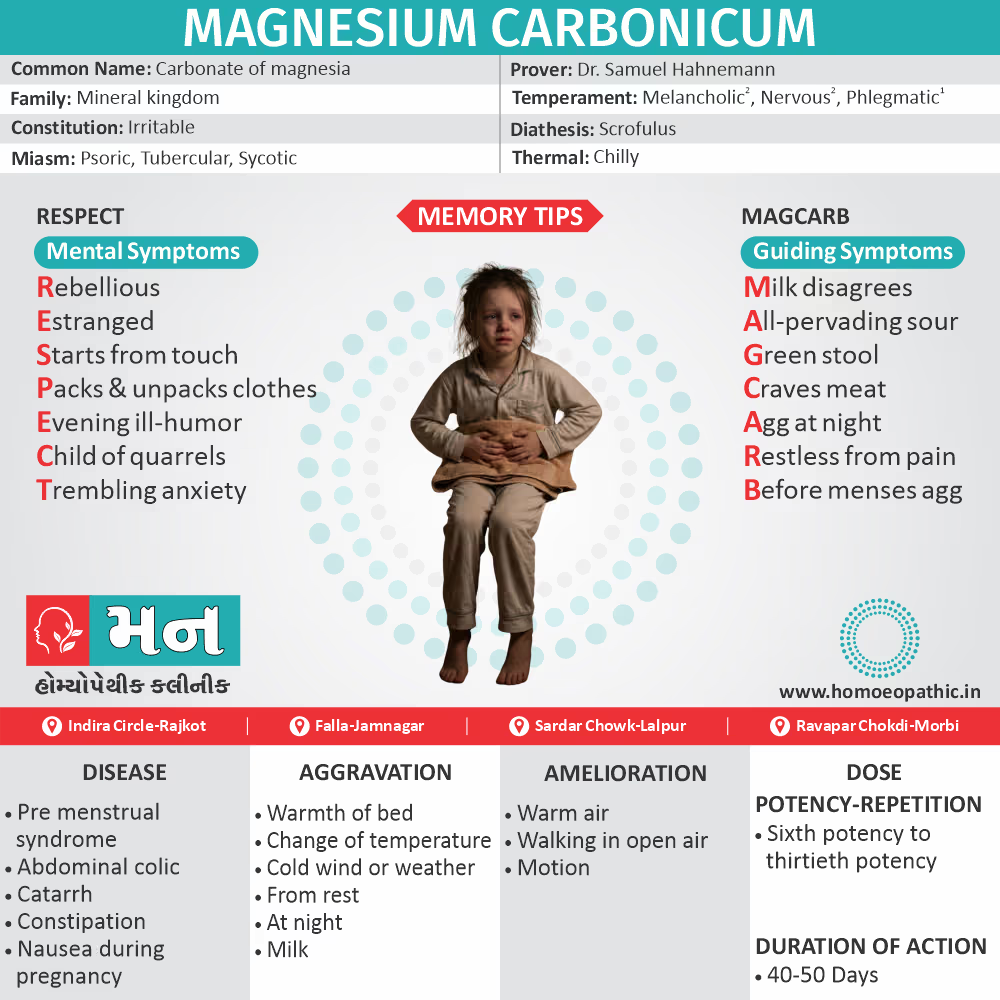
Hi Friends Let’s memorize guidingsymptoms of Magnesium Carbonicum through name of Medicine ‘MAGCARB’.
M
A
G
C
A
R
B
M
M – Milk disagrees
Description: A hallmark symptom of Magnesia Carbonica is a strong aversion to milk or an inability to digest it, particularly in children. Milk causes pain in the stomach, leads to excessive flatulence, and is often vomited up in sour, undigested curds. This intolerance is a key indicator for this remedy.
Reference: [Boericke’s Pocket Manual of Homoeopathic Materia Medica & Repertory]
A
A – All-pervading Sour
Description: The entire patient presentation is characterized by sourness. The whole body, especially in children, emits a sour odor that persists even after bathing. The sweat, stool, urine, eructations, and vomit are all sour. This general state of acidity is a foundational keynote of the remedy.
Reference: [Concise Materia Medica of Homoeopathic Remedies by S.R. Phatak]
G
G – Green stool
Description: The diarrhoeic stool is highly characteristic. It is green, watery, and frothy, famously described as looking like the scum on a frog pond. The stool may also contain white, tallow-like lumps floating on the green liquid. This specific type of stool is a strong guiding symptom, especially during dentition.
Reference: [Allen’s Keynotes and Characteristics with Comparisons]
C
C – Craves meat
Description: Despite having a generally weak digestion and a notable aversion to vegetables and milk, the Magnesia Carbonica patient often has a strong, specific craving for meat. This desire for meat in an individual who can tolerate little else is a peculiar and guiding symptom.
Reference: [A Dictionary of Practical Materia Medica by J.H. Clarke]
A
A – Agg at night
Description: Many physical complaints become significantly worse at night. Neuralgic pains, especially toothaches, are notoriously severe after dark, often becoming unbearable. The pain is so intense that it drives the patient out of bed, forcing them to walk the floor for hours to seek relief. This distinct nocturnal aggravation is a powerful feature of the remedy.
Reference: [Lectures on Homoeopathic Materia Medica by J.T. Kent]
R
R – Restless from Pain
Description: The pains are accompanied by marked physical restlessness. This is not just a nervous fidgeting but a desperate, anxious tossing and turning. The individual is driven to move constantly, unable to find a comfortable position or get any relief while staying still. This is especially true for the neuralgic pains that are worse at night.
Reference: [Systematic Materia Medica Of Homoeopathic Remedies By Dr. K. N. Mathur]
B
B – Before menses agg
Description: A variety of symptoms consistently appear or are aggravated just before menstruation begins. The patient may suffer from a recurring sore throat, sharp colicky pains, backache, or debilitating weakness in the premenstrual phase. The menses, when they arrive, are often dark, thick like pitch, and notably flow more profusely at night or while lying down.
Reference: [The Guiding Symptoms of our Materia Medica by C. Hering]
Memory Tips for Mental Symptoms
Hi Friends Let’s memorize mental symptoms of Magnesium Carbonicum through name of Medicine ‘RESPECT’.
R
E
S
P
E
C
T
R
R – Rebellious
Description: “So the children would either become rebellious, or they would swallow their aggression.”
Explanation: This rebelliousness is a direct response to a feeling of not being seen, valued, or respected. The Mag-c child has a profound need to be recognized and accepted. When this doesn’t happen naturally, they feel their self-worth is threatened. The aggression and rebellion become a tool to force the environment (parents, caregivers) to acknowledge their presence and give them the respect they crave. It is a fight against being ignored or dismissed.
Reference: [Minerals Of Homoeopathy By Jan Scholten]
E
E – Estranged
Description: “Kent (1983a, page 656) describes Mag-c as his first choice of remedy for orphans.”
Explanation: The “orphan” feeling is the core emotional state of Mag-c. It stems from a deep feeling of not being appreciated or valued by their caregivers. They interpret situations like parents quarreling or being sent away as proof that they “are not worth anything” and could therefore be easily abandoned. This creates a profound sense of being alone, uncared for, and fundamentally disrespected, like an orphan in an institution with no one to stand up for them.
Reference: [Minerals Of Homoeopathy By Jan Scholten]
S
S – Starts from touch
Description: “Least touch causes starting.”
Explanation: This physical hypersensitivity is a manifestation of the constant inner anxiety and fear. The mind is in a state of “trembling, anguish, and fear, as if some accident would happen.” This high level of nervous tension and apprehension makes the body jumpy and over-reactive to any unexpected external stimulus, such as a light touch.
Reference: [Concise Materia Medica Of Hom. Remedies By S.R. Phatak]
P
P – Packs & unpacks
Description: “Dazed feeling; packs and unpacks her clothes, without consciousness of having done so.”
Explanation: This peculiar symptom reflects a state of mental abstraction and profound inner turmoil. The individual is so consumed by their sadness, anxiety, or feelings of worthlessness that they “check out” mentally. They enter a “dazed” or absent-minded state, performing repetitive, purposeless actions automatically, without conscious thought or awareness. It is an outward sign of an overwhelmed and disconnected mind.
Reference: [Concise Materia Medica Of Hom. Remedies By S.R. Phatak]
E
E – Evening ill-humour
Description: “Ill-humour in evening.”
Explanation: This is a key modality of the remedy. It is a consistent and characteristic pattern. In homeopathy, such time-based aggravations are considered very reliable indicators for a remedy, suggesting a natural rhythm to the person’s suffering that is part of the remedy’s overall picture.
Reference: [Dictionary Of Practical Materia Medica (All 3 Vol.) By Clarke J. H.]
C
C – Child of quarrels
Description: “Both are first choice remedies for children of quarrelling or divorced parents.”
Explanation: Mag-c is suited for these children specifically when the child’s reaction is centered on respect and self-worth. The child may internalize the conflict, feeling that the parents are fighting about them because they are “troublesome and aggressive.” Alternatively, they feel the parents’ disregard for each other translates into a disregard for the child, reinforcing the core feeling that “he is not appreciated” or considered worthless.
Reference: [Minerals Of Homoeopathy By Jan Scholten]
T
T – Trembling anxiety
Description: “Trembling, anguish, and fear, as if some accident would happen all day, going off after going to bed.”
Explanation: This is not a fear of a specific, known thing, but a constant, free-floating anxiety about the future. It’s a persistent sense of dread that something terrible is about to occur. This continuous state of apprehension puts the nervous system on high alert, manifesting physically as trembling and a deep sense of anguish. The relief upon going to bed is a key feature, indicating a temporary escape from the waking anxieties.
Reference: [Dictionary Of Practical Materia Medica (All 3 Vol.) By Clarke J. H.]
Introduction
Constitution
Clinical
Mental Symptoms
Guiding Symptoms
Characteristic
Therapeutic Value
Modality
Remedy Relationship
Dose
Terminologies
Reference
Also Search As
Introduction
Introduction of Magnesium Carbonicum
Common name:
Carbonate of Magnesia [1]
Synonyms
Magnesium carbonate
Family / Group / Class / Order
Mineral Kingdom
Habit and habitat / Description
Carbonate of Magnesia, chemically known as magnesium carbonate is most commonly a white, odorless, and tasteless solid. Its physical form varies depending on its specific type, ranging from a very light, fine powder (in its basic form) to a denser, granular, or crystalline substance (as the mineral magnesite). While its texture and bulk can differ, it is characteristically insoluble in water but will dissolve in acids, producing effervescence.
Formula / Symbols
(MgCO3)4Mg(OH)2. 5H2O
Name of prover
Dr Hahnemann
Introduction and history
Water containing magnesia is soft; and it has
been observed that this softness has a soothing effect on the nervous system when
used in a bath. Thus magnesia carbonica is an excellent remedy for exhausted
nerves and worn out conditions.[2]
Preparation
The homeopathic medicine Magnesium Carbonicum is prepared from the raw, insoluble mineral salt Magnesium Carbonate through a specific pharmaceutical process called potentization. Initially, the substance undergoes trituration, where it is meticulously ground with lactose (sugar of milk) in specific ratios to break it down to a molecular level and render it soluble. This grinding process creates the initial solid potencies. Following this, the triturate is dissolved in a liquid vehicle, typically a mix of alcohol and water, to begin the liquid phase. Higher potencies are then created through a sequence of serial dilution and vigorous shaking, known as succussion. In this step, one part of the preceding potency is diluted in 99 parts of new liquid and succussed forcefully to create the next strength, a process that is repeated to produce the full range of potencies (e.g., 30C, 200C) used in clinical practice.
Constitution
Constitution of Magnesium Carbonicum
Physical make up
The physical makeup of a person needing Magnesium Carbonicum is typically one of nervous exhaustion and poor nourishment, often seen in delicate, scrawny children who fail to thrive and develop a characteristic distended ‘pot-belly’. A defining feature of this constitution is a pervasive sour odor emanating from the entire body, including sweat and all discharges, which persists despite washing. These individuals are constitutionally chilly, hypersensitive to the slightest touch and cold drafts, and are prone to severe neuralgic pains, like excruciating toothaches, that are notably worse at night.
Temperament
Melancholic2,Nervoous2,Phlegmatic 1
Diathesis
Scrofulous
Relation with heat & cold
Chilly
Miasm
Psoric, Sycotic, Tubercular[3]
Clinical
Clinical conditions of Magnesium Carbonicum
Antrum of Highmore, affections of. Ascarides. Catarrh. Constipation. Cornea, opacities of. Cough. Deafness. Debility. Diarrhoea. Dyspepsia. Eyes, inflammation of. Hernia. Menorrhagia. Menstruation, delayed. Metrorrhagia. Nervousness. Neuralgia. Neurasthenia. Pregnancy, nausea of, toothache of, Spleen, pain in. Taste, disordered. Tinnitus. Toothache. Tumours.[4]
Sites of action / Pharmacodynamics
The primary sites of action for Magnesium Carbonicum are the digestive system, particularly the stomach and liver, and the nervous system, with a strong affinity for the trigeminal and peripheral nerves. It also profoundly affects the female reproductive organs, the body’s overall nutrition and metabolism, and fibrous tissues, including muscles and joints. The mind is also a key sphere of its influence.
Causation (Causes / Ailments from)
-Shocks, blows
-Vexations
-Excess of care and worries
-Mental distress
-Dentition
-Milk, injudicious feeding
-Fits of passions
-Pregnancy
-Cutting wisdom tooth
Physiological action
l – This agent produces irritation and catarrh of the mucous membrane of the alimentary tract, with acid and sour eructations, sour smelling, flatulent stools and sour perspiration. It also acts upon the genital organs of the female, disturbing menstruation.[5]
Mental Symptoms
Characteristic Mental Symptoms (psychology) of Magnesium Carbonicum
1. Anxiety during the day, as if some accident would happen, ameliorated in
the evening in bed.
2. PEACEMAKERS, intolerance to quarrels, confrontations or disharmony.
3. Fear of aggression or violence.
4. Sad, taciturn, packs and unpacks her clothes, without the consciousness of
having done so.
Guiding Symptoms
Guiding Symptoms of Magnesium Carbonicum
Generalities
Gastro-intestinal catarrh, with marked acidity. Often used with advantage for complaints arising in people who have been taking this drug to sweeten the stomach. Is frequently indicated in children; whole body smells sour, and disposed to boils. Broken- down, “worn-out” women, with uterine and climacteric disorders. With numbness and distention in various parts and nerve prostration. Sensitive to the least start, noise, touch, etc. Affections of the antrum ofHighmore. Effects of shock, blows, mental distress. Sense of numbness; nerve prostration; tendency to constipation after nervous strain; SENSITIVE TO LEAST TOUCH, it causes starting, or cold winds or weather or from excess of care and worry with constipation and heaviness. Intense neuralgic pains.
Head
Sticking pain in the side of the head on which he lies as if the hair was pulled; worse, mental exertion. Itching of scalp worse in damp weather. Pain above margin of right orbit. Black motes before eyes.
Ears
Diminished hearing. Deafness; comes suddenly and varies. Numbness of outer ear. Feeling of distention of middle ear. Subdued tinnitus.
Face
Tearing pain in one side; worse, quiet; must move about. Toothache, especially during pregnancy; worse at night; worse, cold and quiet. Teeth feel too long. Ailments from cutting wisdom teeth. [CHEIRANTHUS.] Pain in malar bone, worse during rest, night. Swelling of malar bone with pulsating pain, worse exposure to cold wind.
Mouth
Dry at night. Sour taste. Vesicular eruption; bloody saliva. Sticking pain in throat; hawking up fetid, pea-colored particles.
Stomach
Desire for fruits, acids, and vegetables. Eructations SOUR, AND VOMITING OF BITTER WATER. Craving for meat.
Abdomen
Rumbling, gurgling. Dragging towards pelvis. VERY HEAVY; contractive, pinching pain in right iliac region.
Stool
Preceded by griping, colicky pain. GREEN, WATERY, FROTHY, LIKE A FROG-POND’S SCUM. Bloody mucous stools. MILK PASSES UNDIGESTED IN NURSING CHILDREN. SOUR, with tenesmus [RHEUM.] Constipation after mental shock or severe nervous strain.
Sexual Organ
SORE THROAT BEFORE MENSES APPEAR. Before menses, coryza and nasal stoppage. Menses too LATE AND SCANTY, thick, dark, like pitch; mucous leucorrhoea. Menses flow only in sleep; more profuse at night [AMM. M.], or when lying down; cease when walking.
Respiratory System
Tickling cough, with SALTY, bloody expectoration. Constrictive pains in chest, with dyspnoea. Soreness in chest during motion.
Extremities
Tearing in shoulders as if dislocated. Right shoulder painful, cannot raise it. [SANG.] Whole body feels tired and painful, especially legs and feet. Swelling in bend of knee.
Skin
Earthy, sallow and parchment-like; emaciation. Itching vesicles on hands and fingers. Nodosities under skin. Sore; sensitive to cold.
Fever
Chilly in evening. Fever at night. Sour, greasy perspiration.
Characteristic
Important characteristic features of Magnesium Carbonicum
Keynotes / Redline
1. SOURNESS of all discharges- stool, vomitus, diarrhoea, perspiration.
2. Great neuralgic lightning-like sharp unbearable pains; cannot sit still, causes restlessness, must constantly move about.
3. MILK intolerable, passes undigested.
4. STOOL GREEN, SOUR, FROTHY.
5. Menses – DARK BLACK, PITCH LIKE, INDELIBLE. Sore throat, coryza, weakness, obstruction of nostril, headache preceeds the menses. Flow < night < lying down > moving about.
Guiding
An all-pervading sour odor of the entire body, including sweat and all discharges.
The profound mental state of feeling orphaned, unloved, and forsaken.
Green, watery, frothy stool that resembles the scum on a frog pond.
Unbearable neuralgic pains, particularly toothache, that are worse at night and drive the patient from bed.
Digestive ailments, colic, and an inability to properly assimilate milk.
Confirmatory
1. SOURNESS of all discharges and secretions.
2. Neuralgia, lightning-like sharp unbearable pain < when at rest > moving about.
3. Extreme sensitiveness to COLD, drafts of air, uncovering.
Nucleus symptoms
-Exhaustion – Lassitude, short walking fatigues, unrefreshing sleep, whole body feels tired. Exhausted Nerves.
-Sensitiveness – < cold, < draft of air < uncovering < change of weather.
-Spasms or cramps. Colics – of stomach and intestine.
-Neuralgia remedy -especially left sided, causes unbearable pain, restlessness > moving about.
-Emaciation, marasmus, children do not thrive.
-Sourness of whole body, all secretions and discharges.
Therapeutic Value
Therapeutic Value of Magnesium Carbonicum
Chronic fatigue syndrome, Colic, Constipation, Failure
to thrive, Hepatitis, Insomnia, Neuralgia, Premenstrual syndrome.
Modality
Modality of Magnesium Carbonicum
Aggravaion
Warmth of bed
Change of temperature
Cold wind or weather
Every THREE WEEKS
From rest
At night
Milk
Amelioration
Warm air
Walking in open air
Motion.
Remedy Relationship
Remedy Relationship of Magnesium Carbonicum
Complimentary
Cham.
Follows Well
Caust, Merc, Phos, Puls, Sep, Sil, Sulph
Antidoted By
Ars, Merc
It Antidotes
Acet-ac
Comparison
Mag-m, Mag-p, Aloe, Ant-c, Rheum, Rat (toothache during
pregnancy), Rheum, Kreos, Aloe, Cheir (deafness, otorrhoea, nose stopped up at
night from irritation of cutting wisdom teeth).
Dose
Dose of Magnesium Carbonicum
Third to thirtieth potency.
Potency
Third to thirtieth potency and higher
Duration of Action
40-50 Days
Terminologies
Terminologies of Magnesium Carbonicum
General Homeopathic Terminology
Remedy:
A substance from a natural source, prepared through a special process of dilution and shaking (potentization) to be used as a medicine.
Materia Medica:
An encyclopedia-like book that lists homeopathic remedies and the mental, emotional, and physical symptoms they are known to address.
Repertory:
An index of symptoms that lists all the remedies associated with each specific symptom, often graded by importance.
Synoptic Key:
A learning tool, usually an acronym, used to memorize the most characteristic symptoms of a remedy.
Keynote:
A unique, peculiar, or strongly characteristic symptom that clearly points to a specific remedy.
Modality:
Any condition or circumstance (like time of day, temperature, or motion) that makes a symptom or the patient’s general state better or worse.
Aggravation / Amelioration:
Terms for a modality: Aggravation means a symptom gets worse; Amelioration means a symptom gets better.
Etiology:
The root cause or triggering event of a disease or set of symptoms, which can be physical or emotional.
Specific Magnesium Carbonicum Terminology
Orphan Feeling
A profound emotional state of feeling abandoned, unloved, and disrespected, regardless of whether the person is a literal orphan.
Sourness (as a General State):
A keynote condition where the entire body’s metabolism is acidic, causing all excretions and the body itself to have a sour odor.
Frog-Pond Scum Stool:
A descriptive term for a specific type of diarrhea that is green, watery, and frothy, resembling the algae on a pond.
Dentition:
The medical term for the period of teething, when an infant’s teeth erupt through the gums.
Neuralgic Pains:
Sharp, shooting, or burning pain that follows the path of a nerve.
Reference
Reference of Magnesium Carbonicum
[1] Allen’s Keynotes
[2] Gems textbook of materia medica by Dr.Patil
[3] Zomeo
[4] Dictionary Of Practical Materia Medica (All 3 Vol.) By Clarke J. H.
[5] A Manual Of Materia Medica, Therapeutics And Pharmacology By Blackwood, Alexander Leslie
Also Search As
Also Search As of Magnesium Carbonicum
1. Engage with the Homeopathic Community
This approach focuses on learning through direct interaction with experienced individuals.
Consult a Professional Homeopath:
Speak directly with a practicing homeopath in your area. They possess clinical experience and can provide nuanced insights into Mag Carb that are not found in books, often explaining its use with real-world examples.
Join Study Groups:
Many homeopaths and students form local or online (e.g., on WhatsApp or Telegram) study groups. In these groups, members often share rare articles, discuss complex remedies like Mag Carb, and analyze cases together.
Attend Seminars, Webinars, and Conferences:
The homeopathic community frequently organizes events where senior practitioners present their research and clinical findings. Attending these is an excellent way to get in-depth knowledge and ask questions directly.
2. Consulting Online Homeopathic Resources
Several websites are dedicated to providing reliable homeopathic information. These are excellent places to search directly.
Hpathy.com:
One of the most popular and extensive resources for homeopathy. It features a vast collection of articles, case studies, materia medica, and a monthly journal. Using their internal search bar for “Magnesia Carbonica” will yield numerous results.
Interhomeopathy.org:
An international platform for professional homeopaths, offering high-quality articles, seminars, and case studies. It is an excellent source for in-depth analysis.
The American Journal of Homeopathic Medicine and Homeopathy Journal (by Thieme):
For those seeking peer-reviewed articles, the websites of these journals are the go-to source. They often have searchable archives.
National Center for Homeopathy (NCH):
A reliable source for articles, information, and news related to homeopathy in the United States.
3. Using Academic and Research Databases
For a more scientific approach, these databases are invaluable, though some may require a subscription or university access.
PubMed:
A service of the National Library of Medicine, it includes citations for biomedical literature. A search for “homeopathy” and “magnesium carbonate” might reveal relevant studies.
Google Scholar:
This provides a broad search of scholarly literature across many disciplines and sources. It’s a great tool to find research papers, theses, and articles from academic publishers and professional societies.
ResearchGate:
A social networking site for scientists and researchers to share papers, ask and answer questions, and find collaborators. Many homeopaths and researchers upload their articles here.
Frequently Asked Questions (FAQ)
Item #1
Lorem ipsum dolor sit amet, consectetur adipiscing elit. Ut elit tellus, luctus nec ullamcorper mattis, pulvinar dapibus leo.
Item #2
Lorem ipsum dolor sit amet, consectetur adipiscing elit. Ut elit tellus, luctus nec ullamcorper mattis, pulvinar dapibus leo.
Item #3
Lorem ipsum dolor sit amet, consectetur adipiscing elit. Ut elit tellus, luctus nec ullamcorper mattis, pulvinar dapibus leo.
Lorem ipsum dolor sit amet, consectetur adipiscing elit. Ut elit tellus, luctus nec ullamcorper mattis, pulvinar dapibus leo.
Lorem ipsum dolor sit amet, consectetur adipiscing elit. Ut elit tellus, luctus nec ullamcorper mattis, pulvinar dapibus leo.
Lorem ipsum dolor sit amet, consectetur adipiscing elit. Ut elit tellus, luctus nec ullamcorper mattis, pulvinar dapibus leo.